Kawuneeche Valley Restoration Collaborative Raises $4M to Restore Wetlands
A coalition including Northern Water and CSU is using $4 million to restore the collapsing Kawuneeche Valley wetlands by mimicking beaver behavior to improve water retention and fire resilience.
Aspen —“Zombie willows.” That’s what Kimberly Tekavec calls them.
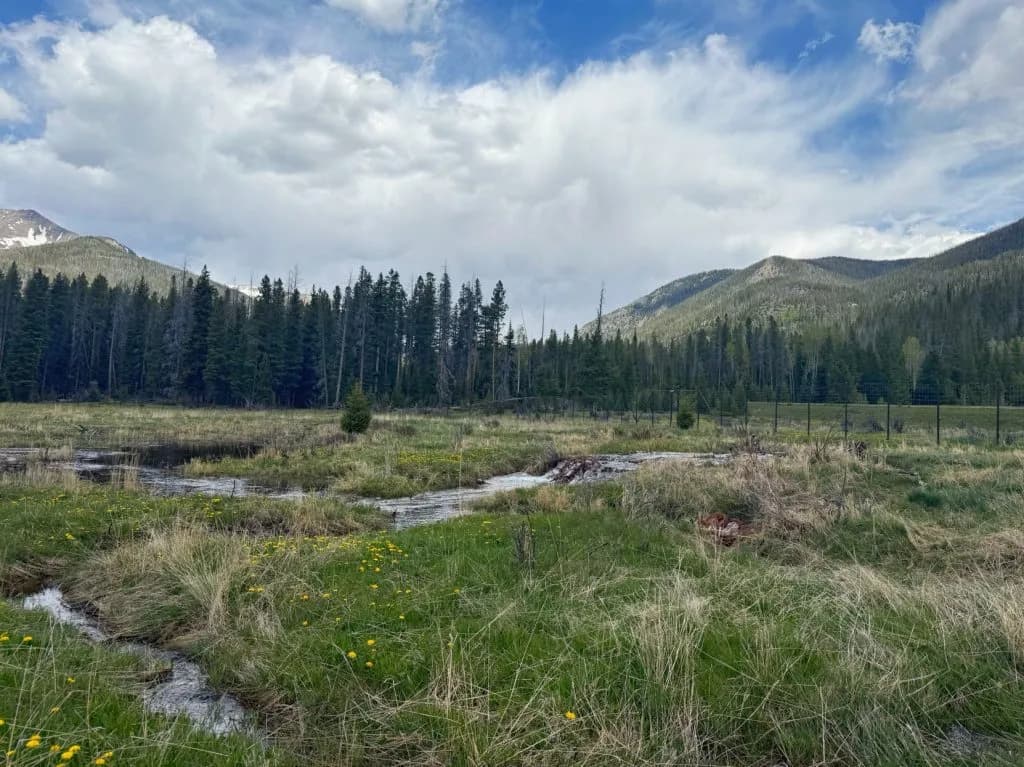
Standing in the Kawuneeche Valley, just downstream from the Colorado River’s headwaters, the dead or dying vegetation looks like a graveyard of a once-thriving ecosystem. For over a century, this wetland complex — once eight miles long and half a mile wide — has been collapsing. The beavers are gone. The water is erratic. And the landscape is dry.
“This valley was once a really significant wetland in Colorado … it was just this really thriving beaver-willow-wetland complex and very biologically diverse,” Tekavec, senior source water protection specialist for Northern Water, told visitors during a June 2 tour. “And over the last 100 years or so, and really significantly in the last few decades; this valley has been severely disrupted, and we’re essentially witnessing, and have witnessed, this ecosystem collapse.”
The solution isn’t concrete. It’s not a new dam. It’s mimicking the work of nature’s original engineers.
Picture this: a beaver gnawing through a cottonwood tree, building a dam, raising the water table, and trapping sediment. Now, imagine doing that on a massive scale across the Never Summer Mountain Range. That’s the premise behind the Kawuneeche Valley Restoration Collaborative, a coalition that includes Northern Water, Rocky Mountain National Park, Colorado State University, Grand County, the town of Grand Lake, the Arapaho-Roosevelt National Forest, the Nature Conservancy, and the Rocky Mountain Conservancy.
They formed the collaborative in 2020. To date, they’ve raised over $4 million. That money isn’t just sitting in a bank account; it’s funding the first of several projects designed to turn dry grassland back into a sponge.
Jeremy Shaw, a research scientist with Colorado State University who has led wetland and stream restoration efforts in the valley, puts it simply.
“A healthy and functioning wetland is a sponge,” Shaw said. “It is a fire break. It is a drought resilience machine. It is a water quality plant. It’s a water treatment plant. So healthy, functional wetlands, particularly ones that support beavers, trap sediment nutrients, output clean, reliable water. It also slows down and spreads out the water.”
Think about that last part. “Slows down and spreads out.” That’s the key. When water rushes down from the mountains, it erodes. It disappears. But when it hits a restored wetland, it lingers. It filters. It waits.
The valley’s decline wasn’t natural. It was a perfect storm of overgrazing by elk and moose, neglected irrigation systems, and changing hydrology driven by human activity. The beavers couldn’t compete with the disruption, so they left. And without them, the valley lost its ability to hold water.
Now, folks are trying to bring them back - not by trapping and moving thousands of animals, but by building the habitat they need. The first project site, located at Beaver Creek, is the test case. On June 2, representatives from the park, CSU, and Northern Water walked state water experts and elected officials through the site. They weren’t just showing off; they were proving that you can engineer resilience by copying what’s already been proven to work.
The stakes are high for the Western Slope. Shadow Mountain Reservoir, the next major stop for the Colorado River, sits just downstream. If the Kawuneeche Valley can’t hold water, that reservoir gets less. The water quality drops. The fire risk rises.
It’s a lesson in humility. We’ve spent decades trying to control water with pipes and dams. We’ve neglected the natural infrastructure that did the job for millennia. Now, we’re spending millions to let beavers do it again.
The zombie willows are still there, waiting. But if the collaborative’s work holds, they’ll be joined by new growth. The water will slow down. The sediment will settle. And the valley will remember how to be a wetland.
Not exactly a new idea. But it’s one we forgot.
Keep up with Aspen
The day's Western Slope news, one email each morning. Free.
NWRM CASA Honors Judge O’Hara and Founders at 15th Anniversary

Craig Hosts Only Regional Special Olympics Bowling Competition