Lake Powell Hits Historic Low, Threatening Hydropower
Lake Powell drops to 3,519.91 feet, nearing the cutoff for hydropower generation, while Lake Mead also hits historic lows, signaling a system under stress as the Bureau of Reclamation manages declining storage.
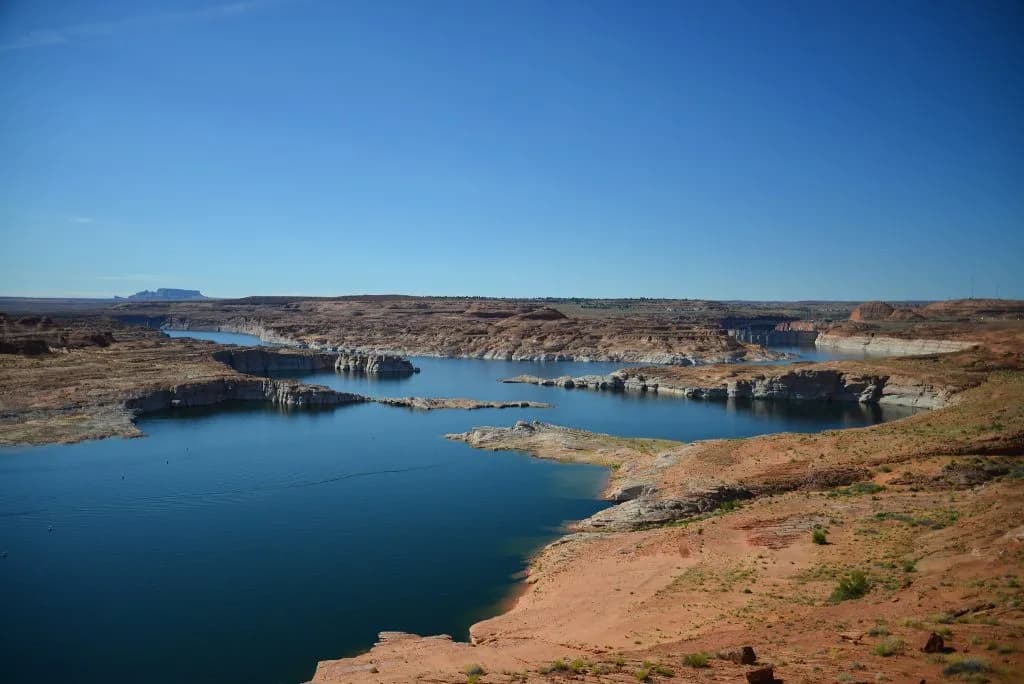
Steamboat Springs —Lake Mead hit 1,040 feet. Lake Powell dropped to 3,519.91 feet. Both reservoirs are now at historic lows for the Colorado River basin, sitting around 27% and 22% full respectively.
The Craig Daily Press reported this week that these levels surpass previous records set in 2022 for Mead and 2023 for Powell. A University of Colorado Boulder research brief notes that the last time combined storage was this low was 1957, during Glen Canyon Dam construction. That was before Lake Powell even filled.
The numbers are stark. For context, the Glen Canyon Dam stops producing hydroelectric power if Lake Powell drops below 3,516.91 feet. We are currently hovering just 30 feet above that cutoff point.
This matters to locals who rely on stable power and water infrastructure. The Bureau of Reclamation manages these two reservoirs. They announced in April that emergency actions were necessary this year to prevent power generation failures. This included limiting releases from Lake Powell to Lower Basin states and pulling water from Flaming Gorge Reservoir in Utah and Wyoming.
The cause is clear. Snowpack in the Upper Basin hit a historic low of 22% this past winter. The Bureau reported that unregulated inflow into Lake Powell during June was only 12% of the 1991-2020 average.
Forty million people across seven states and into Mexico get their water from the Colorado River. Arizona, Nevada, and California draw heavily from these reservoirs. Colorado, Wyoming, Utah, and New Mexico rely more on snowpack. The disconnect between current storage levels and future supply is creating uncertainty for everyone downstream.
The current operating guidelines expire this year. The seven basin states failed to agree on a permanent solution. In response, the Bureau of Reclamation released its final environmental impact statement for post-2026 operations. This framework guides management in two-year increments through 2036.
Sarah Porter, director of the Kyl Center for Water Policy at Arizona State University’s Morrison Institute, was blunt about the outcome. “It isn’t a plan,” she said during an Aug. 6 press briefing hosted by SciLine. “It is a decision-making framework.”
David Rosenberg, a professor at Utah State University’s Department of Civil and Environmental Engineering, added context during the same briefing. He emphasized that this framework allows for adaptability as conditions change, rather than locking states into rigid allocations.
The precarious nature of this management style means that future water releases could fluctuate more than locals are used to. If snowpack doesn’t recover, the emergency measures might become standard practice. That could mean higher costs for water utilities and potential restrictions on agricultural use in the Upper Basin.
The data shows a system under stress. The reservoirs are not just low; they are at their lowest combined levels in nearly 70 years. The political agreement is weak, and the physical storage is depleting.
For people on the Western Slope, this translates to tighter water supplies and a potential increase in operational costs for local utilities. The emergency releases from Flaming Gorge are already affecting flow rates. If Powell hits its minimum power pool, electricity bills could rise as hydropower generation slows or stops.
The Bureau’s framework buys time through 2036. It doesn’t guarantee abundance. It guarantees a process for dealing with scarcity. That’s the practical bottom line: we are managing decline, not recovery.
Keep up with Steamboat Springs
The day's Western Slope news, one email each morning. Free.


How Morapos School Aligned with Ranching Life
Northwest Colorado Ranchers Face 50 Percent Herd Losses Amid Federal Water Plan