Los Angeles Transit Passes World Cup Test Ahead Of 2028 Olympics
Los Angeles used World Cup matches to prove its Metro system can move tens of thousands without cars, setting the stage for a car-free 2028 Olympics.
Aspen —Los Angeles is betting its reputation as the ultimate car-centric sprawl on a World Cup.
It’s a bold pivot for a city where the default assumption is that you’re either stuck in gridlock or paying $50 for a ride-share. But for the 2028 Olympics, organizers aren’t just planning for transit; they’re demanding it. The plan is a “no car” Games. No parking at venues. No driving. Just trains, buses, and shuttles.
To see if the system can actually handle the pressure, Metro didn’t wait for the Olympic athletes to arrive. They used the 2026 FIFA World Cup’s eight LA games as a dress rehearsal. The goal was simple: prove that a decade-old, often-maligned public transit network can move 50,000 people efficiently without turning into a chaotic mess.
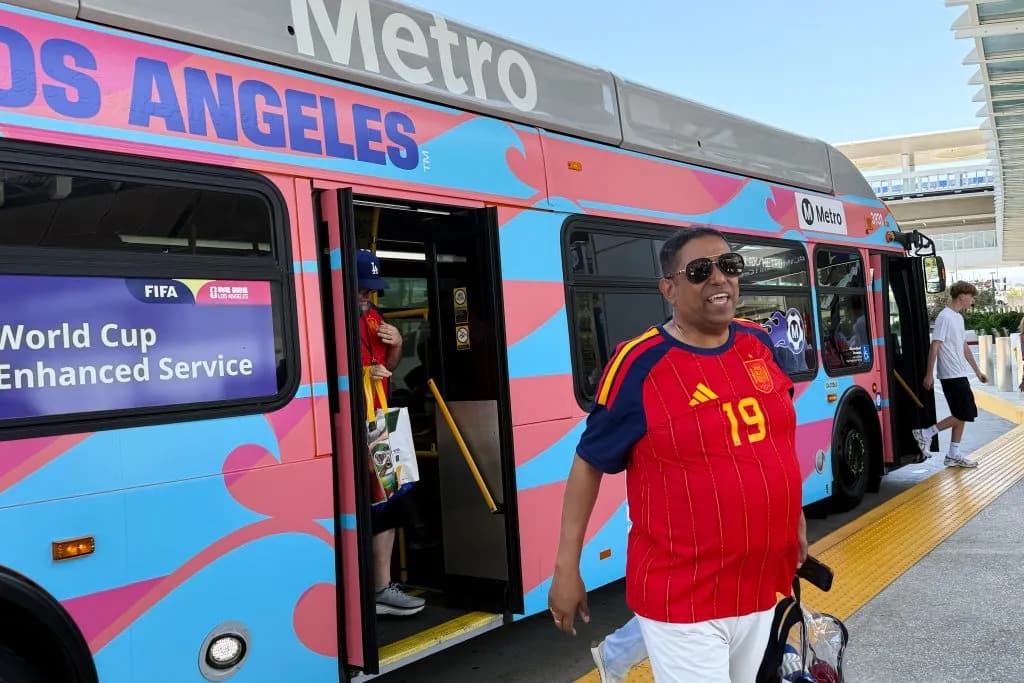
The early data suggests the experiment is working. For the July 2 match between Spain and Austria, nearly 50,000 rides were logged on rail lines. That’s a significant volume for a system that doesn’t even have a direct train line to SoFi Stadium in Inglewood.
The workaround? A massive shuttle network.
Metro added 15 shuttle lines to bridge the gap between major rail stations and the stadium. The longest route took an hour and 15 minutes. More than 30,000 people used those shuttles for that single game alone. It’s a logistical hurdle, but it’s a manageable one.
“It seems like a very functioning transit system, which is somewhat surprising given its reputation,” said Matthew Smith, who took his five-year-old son to the game via transit from their nearby coastal city.
It was Smith’s first time on the LA Metro in ten years. He expected the usual chaos. He got a functioning system.
That’s the reaction officials are banking on. They’re using the World Cup to reintroduce locals and visitors to a network that often feels like an afterthought in a city built for the automobile. And they’re preparing for a scale that dwarfs this tournament.
For the World Cup, the agency borrowed about 200 buses to meet the surge. For the Olympics, they’ll need to borrow 3,000.
The math holds up, but the perception problem remains.
In New York, transit is baked into daily life. In Chicago, it’s a lifeline. In Los Angeles, it’s often viewed as unreliable, dirty, or unsafe. LA Metro estimates the system provides about 1 million rides a day — roughly the same as Chicago, a smaller city. New York pushes well over 3 million on an average weekday.
Why the disparity? Fear.
High-profile incidents, like the 2024 stabbing death of a 67-year-old woman on a Metro train, have cemented a narrative of danger. Riders worry about drug use, cleanliness, and the visible presence of homeless populations.
Metro is trying to fix the perception by fixing the safety.
In June, the agency opened applications for its own police force, aiming to fully deploy it by 2029 to replace the LAPD. The idea is straightforward: sworn officers working alongside homeless outreach and crisis response teams will make the trains feel safer.
The agency is also pointing to the numbers. Metro reports a 13.6% decrease in overall violent crime in March 2026 compared to the previous year.
But data doesn’t always change how people feel.
Martha Banuelos, a long-time resident, used to ride sporadically. Then she started avoiding it “like the plague.” She’s now riding again, driven by the same incentives pushing everyone else: the need to get to the stadium, the promise of fewer cars, and the hope that the system has finally grown up.
The World Cup was the test. The Olympics will be the final exam. If the shuttles run on time and the crime stays down, Los Angeles might just convince its drivers to leave the cars at home.
Keep up with Aspen
The day's Western Slope news, one email each morning. Free.