Roaring Fork Valley Officials Discuss Traffic Congestion Solutions
The Elected Officials Transportation Committee gathered to address traffic congestion in the Roaring Fork Valley, discussing funding and future projects to alleviate the issue.
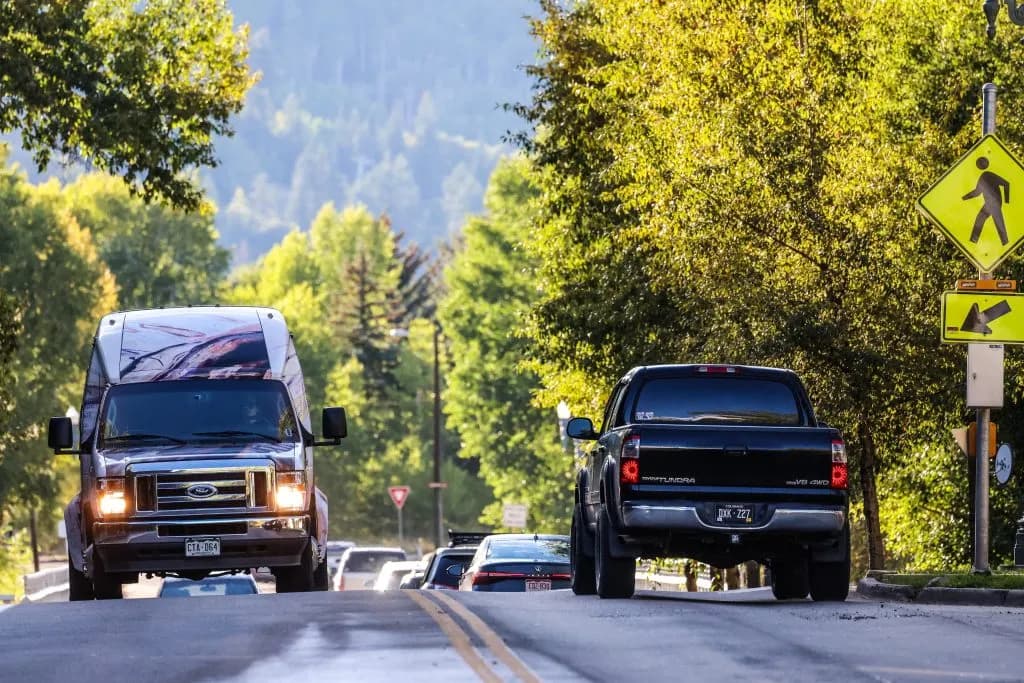
Aspen —On a crisp Thursday morning in the Roaring Fork Valley, the sound of traffic hums along Highway 82, a constant reminder of the congestion that plagues the area. The Elected Officials Transportation Committee gathered to discuss this very issue, questioning the scope of their budget and future projects. As they delved into the details, it became clear that the committee's focus on the valley might not be enough to address the complexities of traffic and transportation in the region.
Aspen Mayor Rachael Richards pointed out that while 10% of Aspen's workforce commutes from as far as Rifle, New Castle, and Parachute, "they're not contributing in the same way our public is" to solutions. This raises the question of whether the current funding structure is equitable, considering the impact of commuters on the community. The 1% Mass Transit Tax, which funds mass transit services in the valley, is distributed based on the proportionate share of the tax collected in each jurisdiction. However, this distribution might not accurately reflect the needs of the entire region.
Pitkin County Commissioner Francie Jacober emphasized that 50% of the traffic passing through Glenwood Springs is headed to Aspen. She stressed that the committee needs to consider the impact of these commuters on the community of Glenwood Springs and take responsibility by distributing efforts and spending money throughout the entire valley. Jacober also noted that Garfield County, which is not currently a member of the Roaring Fork Transportation Authority (RFTA), should be contributing to the buses and transportation efforts. "It's a glaring hole in the continuity in our valley," Jacober said.
The numbers back up Jacober's concerns. The 2026 budget presented at the meeting shows a beginning available fund balance of $11,971,217, with an ending available fund balance of $13,579,012. There is also $6,000,000 in reserve for the Snowmass Transit Center. However, the question is whether this funding is being allocated effectively to address the transportation needs of the entire valley. Snowmass Town Council Member Tom Fridstein agreed with Jacober, stating that "Garfield County needs to step up and help out with the transportation, which they haven't done." Fridstein added, "We can't solve everybody's problem."
As the committee discussed the scope of their focus and budget, it became clear that there are differing opinions on how to proceed. Aspen Mayor Rachael Richards voiced concern that it feels as though the EOTC is carrying the weight for RFTA. "It was anticipated that the downvalley community would start finding their own funding source," Richards said. "The downvalley community has not stepped up to find their own funding source, and we're still carrying the weight." This sentiment highlights the need for a more comprehensive approach to transportation planning, one that takes into account the needs and contributions of all communities involved.
As the meeting came to a close, the committee's discussion had shed light on the complexities of transportation planning in the region. The future of transportation will depend on the ability of local officials to work together and find solutions that benefit all communities. As Pitkin County Commissioner Francie Jacober put it, the committee needs to think about the impact of commuters on the community and take responsibility by distributing efforts and spending money throughout the entire valley. The committee's decisions will have a lasting impact on the region's transportation system, and Jacober's words will likely influence their approach.
Keep up with Aspen
The day's Western Slope news, one email each morning. Free.