Valley Officials Seek Solution to Traffic Congestion
The Elected Officials Transportation Committee discusses traffic congestion and funding in the valley, seeking a more equitable solution for all communities involved.
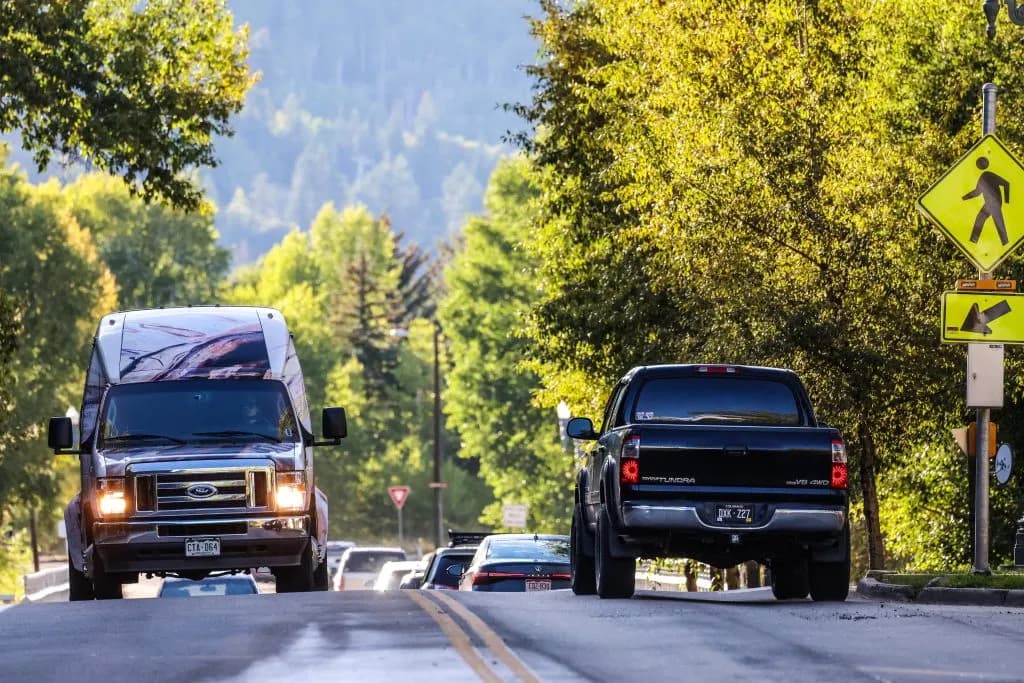
Aspen —What's the plan for addressing traffic congestion in the valley, and who's footing the bill? The Elected Officials Transportation Committee met recently to discuss these very questions, with a focus on the geographic scope of their budget and future projects.
The committee, established in 1993, is comprised of elected officials from Aspen, Snowmass Village, and Pitkin County. They oversee the distribution of a 1% and 0.5% mass transit tax, which funds public transportation services in the valley. The 1% tax is split, with 48.13% going to the Roaring Fork Transportation Authority (RFTA) and 51.87% distributed between Aspen and Snowmass Village. The 0.5% tax is also split, with 81.04% allocated to RFTA and 18.96% set aside for the Transit Sales & Use Tax fund.
For context, the 2026 budget presented at the meeting shows a beginning available fund balance of $11,971,217 and an ending available fund balance of $13,579,012. There's also a $6,000,000 reserve for the Snowmass Transit Center, bringing the total fund balance to $19,579,012. These numbers are significant, but what do they mean for the valley's transportation needs?
Aspen Mayor Rachael Richards pointed out that while 10% of Aspen's workforce commutes from as far as Rifle, New Castle, and Parachute, these communities aren't contributing equally to solutions. This raises questions about the fairness of the current funding structure. Pitkin County Commissioner Francie Jacober emphasized that 50% of the traffic passing through Glenwood Springs is headed to Aspen, highlighting the need for a valley-wide approach to transportation planning.
However, Jacober also stressed that Garfield County, which is not currently a member of RFTA, needs to step up and contribute to commuter efforts. This is a critical point, as the current system appears to be shouldering the burden for the transportation authority. Snowmass Town Council Member Tom Fridstein agreed, stating that Garfield County needs to take responsibility for its share of transportation costs.
On paper, the budget and scope seem straightforward, but in practice, the situation is more complex. The committee is grappling with how to balance the needs of different communities within the region, while also ensuring that each area is contributing its fair share. As Richards noted, it was initially anticipated that downvalley communities would find their own funding sources, but this hasn't happened.
Let's do the math: if 50% of the traffic passing through Glenwood Springs is headed to Aspen, and Garfield County is not contributing to the transportation authority, then it's clear that the current system is unsustainable. The committee needs to rethink its approach and find a more equitable way to distribute funds and resources.
For locals, the practical impact of this discussion is significant. If the committee decides to adjust its budget and scope, it could affect the availability of public transportation services, traffic congestion, and even property values. The committee's decisions will have real-world consequences for people living and working in the valley.
In the end, the committee's challenge is to find a solution that works for the entire valley, not just one or two communities. This will require careful consideration of the budget, scope, and funding structure, as well as a willingness to work with other counties and municipalities to find a more equitable and sustainable approach. The bottom line is that the current system is not working, and it's time for a change.
Keep up with Aspen
The day's Western Slope news, one email each morning. Free.