Russia Hits Kyiv With 21 Missiles Hours After Peace Talks Resume
Russia launched 21 ballistic missiles at Kyiv hours after agreeing to resume peace talks, killing four people and damaging critical energy infrastructure amid ongoing diplomatic efforts.
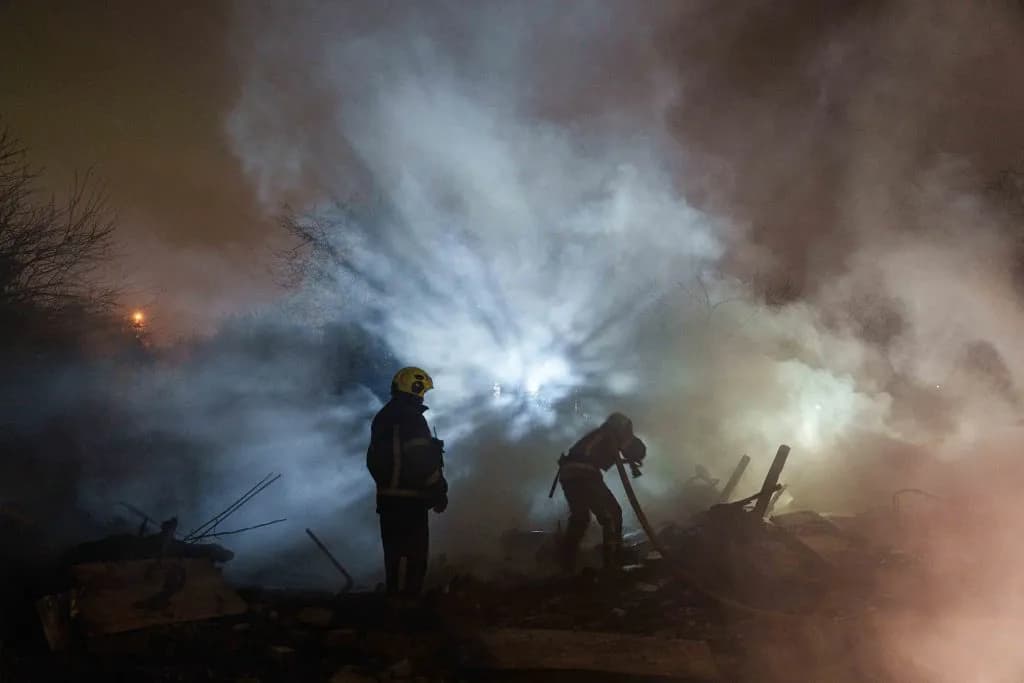
Aspen —The sky over Kyiv turns a bruised purple as the first wave of ballistic missiles screams through the night air. It is a sound that locals describe as a low, guttural roar that vibrates in the chest before the whine of the incoming warheads begins. In the streets below, shadows dance against apartment facades as residents huddle in basements, listening to the city above them shudder under the weight of 21 missiles arriving in three distinct bursts.
This barrage did not happen in a vacuum. It struck only hours after Russian President Vladimir Putin agreed “in principle” to resume three-way negotiations involving the United States. The timing is not lost on anyone watching from the Western Slope, where the geopolitical distance feels less abstract when it translates to heating costs or supply chain delays. The Russian military claimed to have intercepted over 800 Ukrainian drones targeting Moscow and other cities on Thursday, a number that underscores the sheer volume of iron flying across the border.
The human cost is stark. At least four people were killed in Ukraine, and dozens were wounded, including five children. In the northeastern Kharkiv region, a strike on a market in Lozova killed two women, ages 50 and 60. Oleh Syniehubov, head of the regional military administration, confirmed the toll. In Kyiv, one person died as the missiles smashed apartment buildings, energy facilities, a railway station, and the subway system. Three of the ballistic missiles carried cluster munitions, bombs that open in the air to release scores of smaller bomblets.
Volodymyr Zelenskyy, the Ukrainian president, was blunt about what the strikes meant for diplomacy. “Russia has not changed the way it wages this war, and it is taking no steps that would signal a genuine desire to end it,” he said. The sentiment carries weight because the attacks are specifically targeting the power grid. Since October 11, Russia has launched 170 strikes on Ukraine’s critical energy facilities. The goal is to deny civilians heat, light, and running water during the bitterly cold months. Ukrainians call this campaign “weaponizing winter.”
Diplomatically, the situation remains tangled. Steve Witkoff, the envoy for U.S. President Donald Trump, met with Putin in St. Petersburg and spoke of a “new momentum” toward peace. He had also met with Zelenskyy in Norway on Tuesday. Talks are supposed to start sometime after November 10, but no date is set. Previous “technical” rounds in the United Arab Emirates and Switzerland yielded little progress beyond prisoner exchanges. Zelenskyy has insisted that only a meeting of leaders can break the deadlock. The U.S. has proposed the UAE as a venue for these new discussions.
Meanwhile, the diplomatic theater continues elsewhere. The Kremlin says Putin is considering attending the G20 summit in Miami. It is a small detail, but it highlights the strange duality of the moment: heavy metal raining down on a capital city while envoys shake hands in conference rooms.
Back in Kyiv, the noise has faded. The silence is heavier now. Smoke rises from the rubble of a shopping mall, drifting over the frozen Dnipro River. The cold is biting, but the air is still. Somewhere in a basement, a child is awake, listening to the wind. The missiles are gone, but the winter is just beginning.
Keep up with Aspen
The day's Western Slope news, one email each morning. Free.