The chandelier in the East Room glints off the polished floor, casting long, sharp shadows across the carpet
The chandelier in the East Room glints off the polished floor, casting long, sharp shadows across the carpet. It is a scene designed for cameras, a stage set for two men who hold the weight of the world between them.…
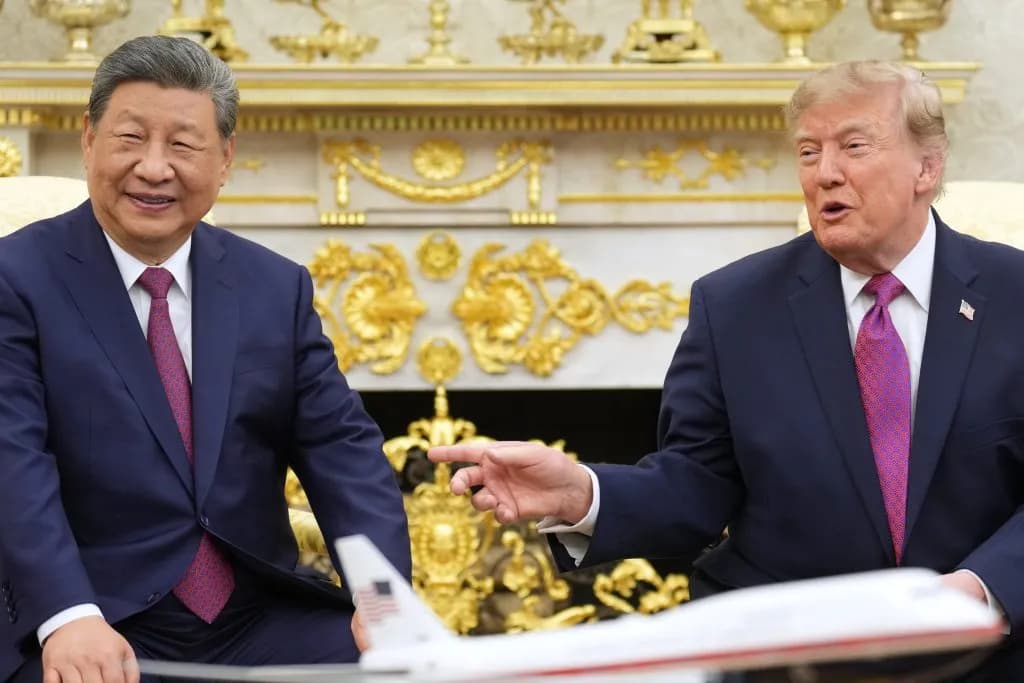
Aspen —The chandelier in the East Room glints off the polished floor, casting long, sharp shadows across the carpet. It is a scene designed for cameras, a stage set for two men who hold the weight of the world between them. But beneath the silk and the state dinner plates, the air is thick with something far less decorative.
Presidents Donald Trump and Xi Jinping met for high-stakes talks on Thursday, an urgent moment for a relationship that feels more like a cold war than a partnership. The Vail Daily reports that while the two leaders are betting on personal rapport to keep the peace, the actual substance of their disagreements remains largely buried under the pomp.
Why is the White House so quiet on the real issues?
That is the question locals and policymakers alike are asking. The Daily notes that the White House has not released a readout of the private talks, and Trump, who usually posts his own take on foreign policy, has yet to weigh in on the substance. Instead, he complained that TV networks “refused to cover one of the Biggest and Most Beautiful Events to take place in many years,” citing the legal fight over barring CNN, MS NOW, and Politico from the White House.
The silence is telling. Xi was more pointed than Trump, stating that Chinese and American interests are “deeply intertwined” and that the “competition should be a healthy one and should be kept within bounds.” He warned against the “Thucydides trap,” the idea that when a rising power threatens to displace an established one, war often follows. “It should be a race of catching up with one another, not a wrestle in which one either wins or loses,” Xi added.
But Xi’s words didn’t stop at philosophy. During their private conversation, he urged Trump to “prudently handle the Taiwan issue,” according to Xinhua. This is the part everyone skips past in the press releases. Beijing considers Taiwan to be Chinese territory and vows to annex the island by force if necessary. The United States is obligated by law to provide Taiwan with sufficient hardware to deter any armed attack from the mainland. Yet, neither side has clarified how that legal obligation squares with Xi’s demand for prudence.
There is also the matter of trade. The two sides agreed on Wednesday to extend by two months a one-year trade truce that was set to expire Nov. 10. They are working to find a more durable agreement, but the details are scarce. China has also resisted the Trump administration’s urgings to use its leverage to prod Iran to agree to U.S. terms to end the nearly seven-month war. Xi wants to see Trump permanently halt arms sales to Taiwan and loosen export restrictions on cutting-edge advanced chips.
These are not minor points. They are the gears that drive the engine of U.S.-China relations. And yet, in the official narrative, they are almost invisible. The focus is on the friendship, the mutual respect, the vital interests of the people. It is a comforting story. It suggests that if the two leaders get along, everything else will fall into place.
But history suggests otherwise. Personal rapport has rarely been enough to prevent conflict between major powers. What matters is the underlying structure of the relationship — the balance of power, the distribution of resources, the alignment of strategic interests. And on that score, the picture is far less rosy.
The two countries are in a generational contest for economic and technological dominance. They are divided on the war in Iran. They are grappling to find common ground on trade. They are navigating the jarring advances of artificial intelligence. These are not issues that can be resolved over a state dinner. They require sustained diplomatic effort, careful negotiation, and a willingness to compromise.
So, what does this mean for us?
It means that the next few months will be critical. The extension of the trade truce gives both sides more time to negotiate, but it also raises the stakes. If they fail to reach a durable agreement, the risk of escalation increases. The same applies to the Taiwan issue. If Trump fails to “prudently handle” it, Beijing may view it as a sign of weakness or indecision, prompting a stronger response.
And then there is the question of Iran. China’s refusal to use its leverage to end the war is a significant blow to U.S. interests. It suggests that Beijing is willing to let the conflict continue, perhaps to keep the U.S. distracted or to weaken its position in the region. If that is the case, the implications are far-reaching.
In the end, the pomp and ceremony are just that — pomp and ceremony. They are the surface layer, the thing that catches the eye and holds the attention. But beneath it, the real work is happening. The negotiations, the compromises, the hard choices. And until we see more of that, the picture remains incomplete.
The chandelier in the East Room still glints off the polished floor. The shadows are long. The cameras are gone. The two men are alone. And in that silence, the weight of the world settles in.
Keep up with Aspen
The day's Western Slope news, one email each morning. Free.




Aspen One Reveals 50 Percent Home Vacancy Rate Fuels Traffic
The rain taps against the windows of the Wheeler Opera House, a steady rhythm that usually signals quiet