Vail Artists Project Music Evolution to 2276 at Aspen Ideas Festival
Three artists argue that music’s future lies in expanding past traditions rather than abandoning them, a philosophy driving the upcoming Vail Dance and Bravo! Vail Music Festival seasons.
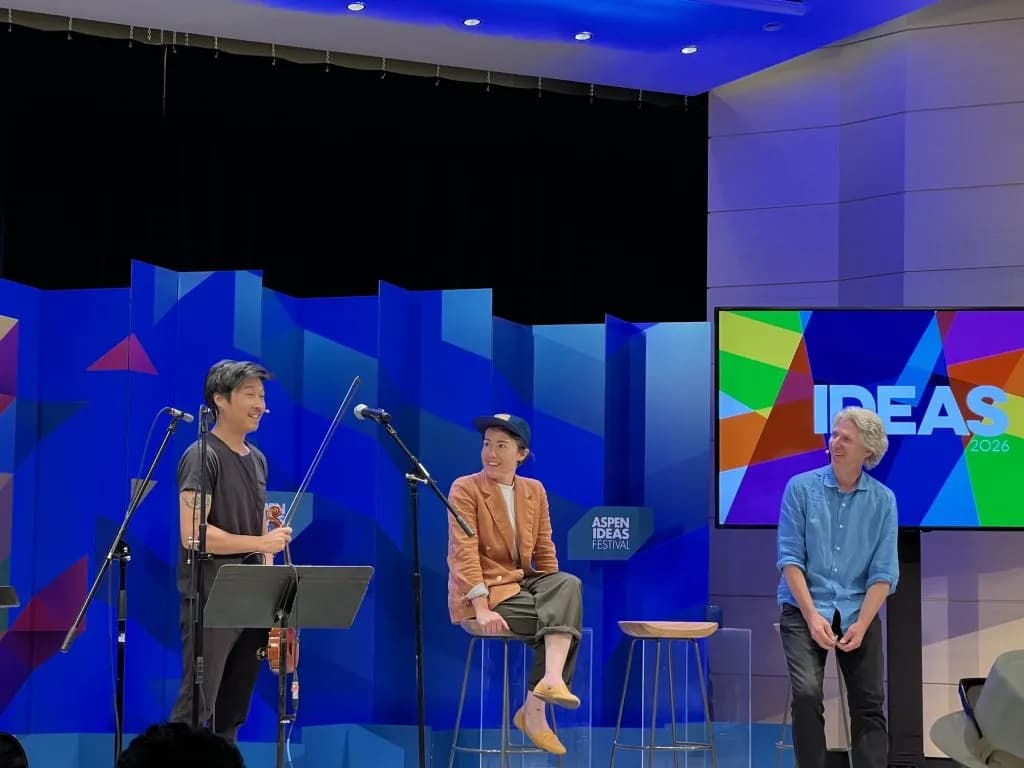
Aspen —The idea that music will sound radically different in 250 years is less about technology and more about the stubborn persistence of human curiosity. That was the counterintuitive takeaway from a panel at the Aspen Ideas Festival on June 29, where three artists argued that while instruments change, the drive to “make new doors and windows out of the old material” remains constant.
Damian Woetzel, artistic director of Vail Dance Festival, sat on that panel alongside Charles Yang and Caroline Shaw. The setting was Aspen, but the relevance lands here in Vail. All three are regulars at local festivals. Shaw has composed for Bravo! Vail Music Festival. Yang performs with the Vail Dance Festival. Woetzel is currently celebrating his 20th year leading the dance festival here.
They weren’t speculating on AI-generated symphonies or neural-linked headphones. They were looking at the trajectory of art from Bach to now, and projecting forward to 2276.
To hear them tell it, the future of music isn’t a departure from the past. It’s an expansion of it.
Yang, raised by Chinese immigrant parents who introduced him to traditional music before he ever heard a violin, and Shaw, who grew up steeped in classical traditions, both found their way into popular genres like rock and blues. Yet they returned to classical forms not as purists, but as innovators.
Shaw describes her compositional process as searching for something that “has always existed but has never been composed.” She doesn’t invent from scratch. She goes internal, imagining a sound that “needs to happen,” one that feels inevitable even if it hasn’t been constructed before.
“It’s this idea of: ‘If the moon was a sound, what might that be?'” Shaw said.
This approach mirrors how dance evolves. Yang noted that while dance steps look nothing like the notation Bach wrote on paper, “it all comes together.” The visual and the auditory merge.
“The context always matters,” Woetzel said.
The panel demonstrated this in real time. Yang and Shaw engaged in an improvisational, nonverbal musical conversation on stage. They didn’t just play; they involved the audience. Shaw coached the crowd to sing “awwww,” guiding them from a casual moan to a robust, revitalizing sound. The result wasn’t just noise. It was a shared experience of delight and joy, underscored by a gentle respect for the collective effort.
For locals who buy tickets to Vail Dance Festival or Bravo! Vail Music Festival, this matters because it defines what they’re paying for. They aren’t buying nostalgia. They’re buying the next iteration of a 250-year-old conversation.
The math holds up: innovation requires context. Without the history of classical structure, without the influence of dance and theater, Shaw’s “moon sounds” would lack grounding. Without Yang’s technical precision from his classical training, the improvisation might drift into chaos.
Woetzel brings the structural framework of dance to this musical exploration. Shaw and Yang provide the sonic texture. The audience provides the emotional resonance.
When you look at the upcoming Vail Dance Festival, running July 31 through Aug. 10, you’re seeing this philosophy in action. Shaw and Woetzel are back in town. They performed “After All This Time” with dancers Michelle Dorrance and Bobbi Jene Smith at NOW Premieres earlier this year. That work was a preview of the synthesis they discussed in Aspen.
The question is whether local audiences will recognize that their tickets support this specific kind of evolution. The answer seems to be yes, given the sustained presence of these artists in our valley.
Shaw’s point about imitating sounds around us to express ideas suggests that music will always reflect the environment we live in. In Vail, that environment is steeped in performance art, tourism, and a community that values high-caliber cultural events.
“We strive to create music that has always existed but has never been composed,” Shaw said. “She goes internal and imagines a sound that needs to happen.”
That’s not just an artistic statement. It’s a business model for the next 250 years of culture here on the Western Slope.
Keep up with Aspen
The day's Western Slope news, one email each morning. Free.