Xi Visits Washington With Lavish Red Carpet Reception
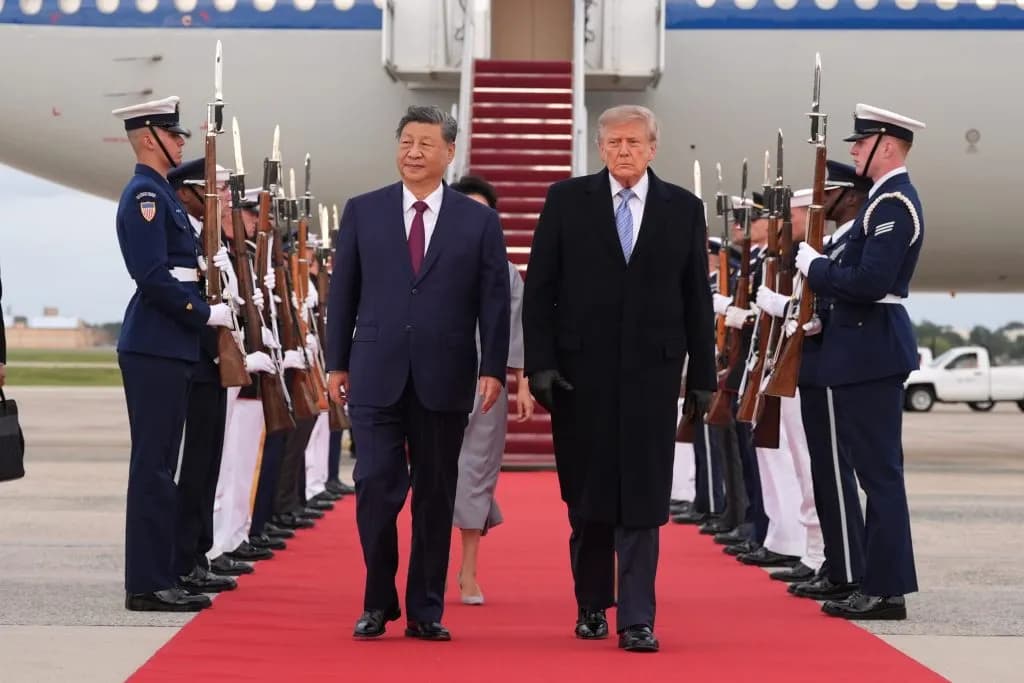
Chinese President Xi Jinping arrived at Joint Base Andrews for a historic three-day state visit, greeted by a 100-foot red carpet, a 21-person honor guard, and an overhead flyby by two B-1 bombers.
Aspen —The wind at Joint Base Andrews doesn’t care about geopolitics. It just cuts through the wool of a heavy overcoat, making the wearer shiver despite the mild 63-degree temperature. President Donald Trump stood on the tarmac, gloved hands at his sides, waiting for the stairs to lower. He wasn’t at the White House. He was here, on the ground, ready to meet the man who had crossed the Pacific to make his first state visit to the U.S. capital in more than a decade.
It was a rare sight. Usually, foreign leaders drive up to the executive residence. But this time, the protocol shifted. A 100-foot red carpet was unfurled at the base of the aircraft stairs. A 21-person honor guard lined the path. Two B-1 bombers flew overhead, their roar echoing across the airfield. When Chinese President Xi Jinping stepped off the plane, accompanied by his wife, Peng Liyuan, the ceremony began. Two American children presented bouquets of yellow flowers. Flags were raised. Anthems played.
Trump removed one glove to shake Xi’s hand. He slapped the Chinese leader on the back. Their words were inaudible to the press corps, but the body language was clear. Warmth. Familiarity.
This three-day visit is designed to be a mirror image of Trump’s May trip to Beijing. The pomp is intentional. The state dinner scheduled for Thursday at the White House will feature the full ceremonial weight of the presidency. But beneath the glittering surface, the friction points remain sharp. Trade disputes simmer. Artificial intelligence competition heats up. The shadow of Trump’s conflict with Iran looms large, especially given China’s perceived support for Tehran. And then there is Taiwan — the island that sits at the center of Beijing’s strategic ambitions.
Not everyone in Washington is charmed by the spectacle. Senator Roger Wicker, the Republican chairman of the Senate Armed Services Committee, took to the floor Tuesday to voice his dissent. He called the reception “lavish” and questioned why Trump had extended such an invitation in the first place. Wicker listed a litany of grievances — China’s military buildup, its ties to Iran, and suggested that Trump should keep in mind that his guest is a “brutal, unelected and oppressive dictator.”
And that matters because the optics of this visit will shape the narrative for months to come. Is it a gesture of goodwill? Or is it a performance of power? The answer, perhaps, lies in the silence between the handshakes. In the moments where the cameras stop rolling and the diplomats begin their real work.
Back on the tarmac, the red carpet is rolled up. The honor guard marches away. The plane taxis toward the runway, engines spooling up. Trump watches it go, his face unreadable behind his sunglasses. The wind picks up again, swirling dust across the pavement. For a moment, the noise fades. Just the hum of the engines. The distant cry of gulls. And the quiet, persistent sense that something bigger is unfolding - something that will ripple outward, touching lives in valleys and cities far removed from this stretch of concrete and sky.
Keep up with Aspen
The day's Western Slope news, one email each morning. Free.