Aspen's New Nell Bell Lift Replaces Two Aging Machines
Aspen Skiing Company opened the new Nell Bell chairlift, replacing two aging machines with a high-speed quad capable of moving 1,800 people per hour.
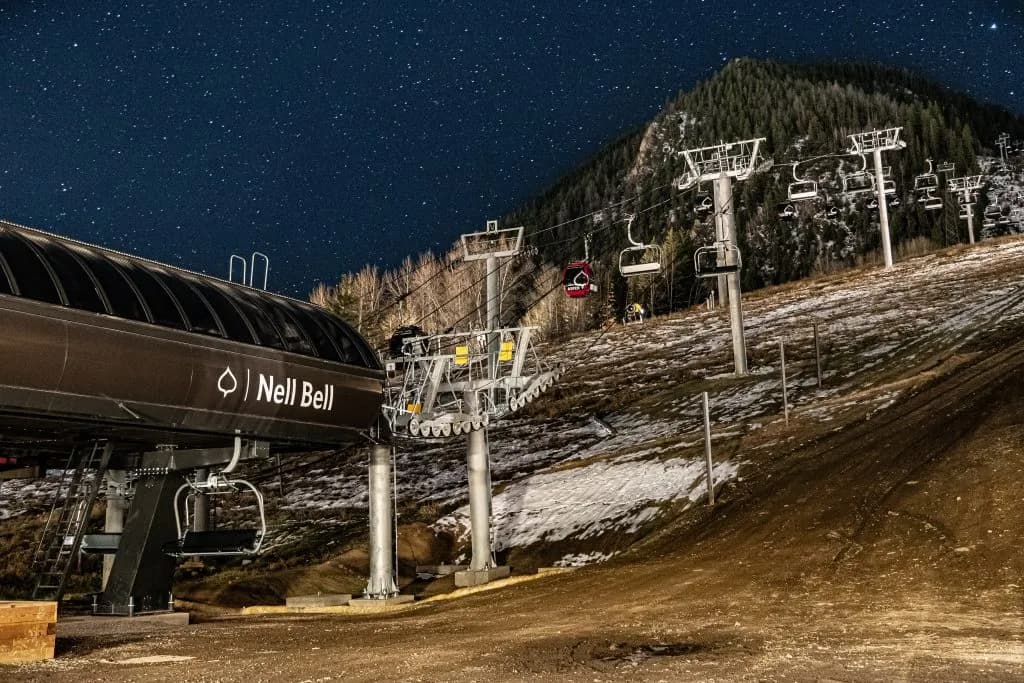
Aspen —The first thing you notice isn’t the speed; it’s the silence. For decades, the ascent up Bell Mountain was defined by the clatter of two aging machines — the 1957 Bell Mountain lift and the 1986 Little Nell — working in tandem to ferry skiers toward the summit. Now, as the new Nell Bell chairlift opens its gates for the winter season, that mechanical noise has been replaced by a smooth, high-speed hum. It is a single, high-speed detachable quad, and it moves with a purpose that feels almost aggressive in its efficiency.
Why does this matter to the person standing in line at Gondola Plaza?
The answer lies in the sheer volume of people the new lift can handle. Geoff Buchheister, CEO of Aspen Skiing Company, noted that the Nell Bell can move 1,800 people per hour. That is a massive jump from the combined capacity of the two older lifts it replaces. This translates to shorter wait times at the base. You aren’t stuck in a queue while the lift slowly churns out riders; you’re moving uphill, and you’re moving fast.
There’s a warmth to the idea that this lift also changes who can access the mountain. Previously, the terrain in the core of the resort required navigating two separate, older lifts. Now, it’s a more intuitive line. Buchheister described it as opening up Bell Mountain to intermediate skiers in a cleaner, faster way. If you’ve ever found yourself wondering why a particular run felt so congested or difficult to reach, this is the infrastructure fix. It distributes guests more evenly across Aspen Mountain, which benefits everyone.
But it’s not just about speed and capacity. There’s an environmental angle, too. The Nell Bell features an all-electric drive system. According to Buchheister, when compared to the two lifts it’s replacing running fully loaded, the new installation consumes less energy. The environmental review, done in collaboration with Aspen, Pitkin County, and the U.S. Forest Service, evaluated wildlife, botany, soils, hydrology, and cultural resources. It’s a detail that might not stop you mid-ski, but it’s part of the larger picture of how the mountain is being managed.
One of the most practical benefits is redundancy. If the Silver Queen Gondola gets shut down due to weather or wind, the Nell Bell keeps guests moving uphill. That’s a safety net that wasn’t as robust before.
As you stand at the base, watching the chairs glide upward against the backdrop of the jagged peaks, you can feel the shift in momentum. It’s not just a new ride; it’s a new rhythm for the mountain. The old lifts served their purpose for nearly 140 combined years, but the new lift is built for a future where flow and accessibility are paramount.
The sun begins to dip below the ridgeline, casting long shadows across the snow. The chairs continue their steady ascent, carrying skiers and snowboarders toward the summit. The air is crisp, carrying the scent of pine and cold snow. As you watch the last few riders disappear over the crest of the mountain, the only sound left is the gentle rustle of the wind through the trees.
Keep up with Aspen
The day's Western Slope news, one email each morning. Free.