Avon Water District Expects Lower Spring Peak After March Heatwave
A March heatwave triggered an early surge in the Eagle River, but water managers predict a lower, delayed peak for Avon this year, raising concerns about late-summer water supplies.
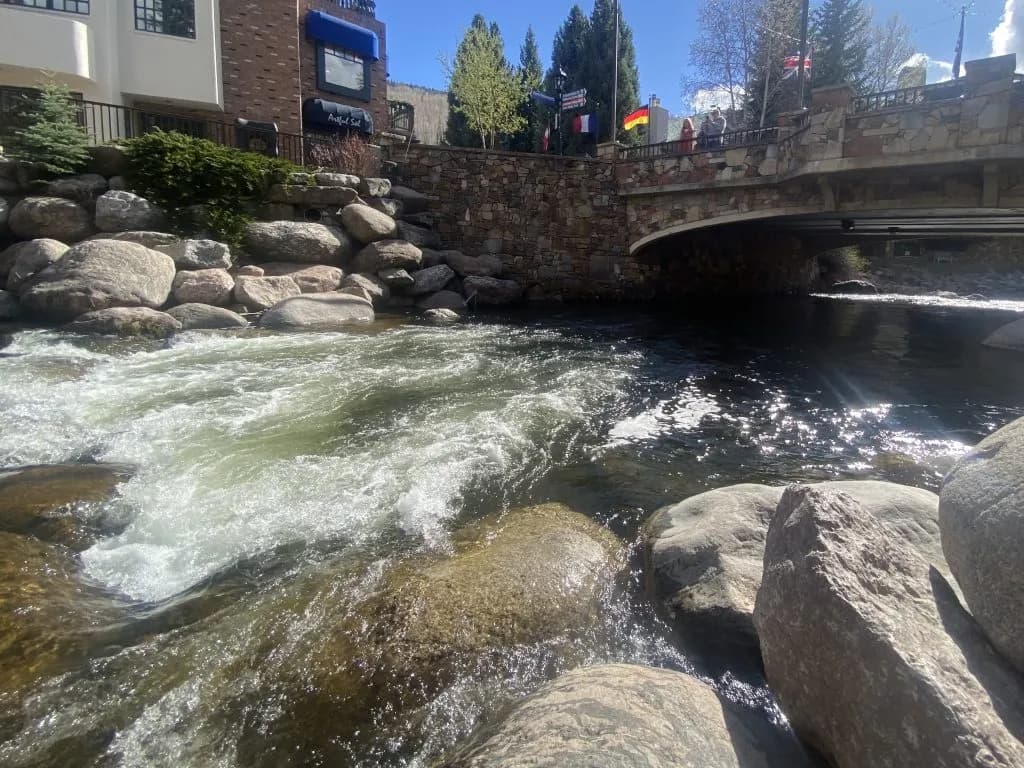
Aspen —The air off the Eagle River in Avon feels different this spring. It’s thinner, sharper. The usual roar of meltwater churning through the channel has softened to a steady, almost polite rush. Downstream, the banks are bare, stripped of the ice that usually clings to them in early April. If you stand on the bridge near the Avon station, you can see the water moving fast, but it doesn’t have the weight of a full season’s snowpack behind it. It’s moving because it’s being pushed, not because it’s flowing freely.
That push came from a heatwave in March that baked the valley, turning white slopes brown in a matter of days. On Vail Mountain, the gauge measuring snow-water equivalent hit 0.0 inches in March for the first time in its 47-year history. By early April, snow had vanished from all south-facing slopes below 11,000 feet. The result was a sudden, violent spike in streamflow that caught water managers off guard.
Gore Creek above Red Sandstone Creek in Vail saw a surge on March 26, hitting 176 cubic feet per second (cfs). The waterway in Avon followed suit, peaking on March 27 at 468 cfs. It was a false dawn. Within days, flows dropped below 200 cfs and settled into a lower rhythm. Now, locals are asking the question that’s been hanging over the water district offices: Is this it? Have we already seen the highest water levels of 2026, or is another peak coming?
The short answer is no, but the long answer is complicated. Flows this year are expected to be about 40% of what they should be in a normal year. Justin Hildreth, a water resources engineer for the Eagle River Water and Sanitation District, notes that this puts the main stem at Avon at a projected peak of about 800 cfs, rather than the average 2,000 cfs.
“That surge takes away from what could flow later in the year,” said Tim Friday, director of water and utility resources for the district. “Water in the form of snow is like money in the bank, and it all depends on the weather from this point forward how it runs off.”
Friday thinks the March 27 peak was just a false summit. He expects another peak later this spring, though it won’t match the volume of a typical year. The comparison to 2012 is the closest we have. That was the second-lowest snowpack year on record, and it lacked this early March surge. In 2012, the Avon station didn’t see readings above 300 cfs until April 1. This year, the gauge stayed above 300 cfs from March 25 to March 31.
“We got an early spike about a month in advance of the normal runoff,” Friday said. “It settled back down because the weather changed; I don’t think this was the peak we’ll see.”
The implications for folks living along the river are subtle but real. Less total water means less irrigation volume for farms downstream, and potentially lower water levels in late summer if the next heatwave hits hard. But for now, the immediate threat of flooding has passed. The danger isn’t a sudden flood; it’s a slow drain.
Friday remains cautious. He’s watching the sky, not just the gauge. If it stays cool, that remaining snowpack will melt slowly, stretching the water supply into July and August. If it heats up again, like it did in March, that “money in the bank” gets withdrawn in a hurry.
“We’re still in the game,” Friday said. “But the game has changed.”
Keep up with Aspen
The day's Western Slope news, one email each morning. Free.

S&P 500 Slips Modestly as Weak Retail Sales and Oil Prices Drive Market Correction

Aspen Essay Connects Generations Through Highway 82 Landmarks