Eagle River Drought Call Forces Junior Users to Stop Diverting Water
The Colorado Division of Water Resources placed a formal call on the Eagle River Aug. 14, requiring junior rights holders to stop diverting water or use augmentation sources.
Aspen —The air in the Roaring Fork Valley hangs heavy and dry, stripped of the usual moisture that clings to the pines after a summer rain. Down in the canyon, the stream runs low, its surface barely wide enough to reflect the jagged peaks of the Elk Mountains that loom above. It’s a quiet kind of tension, the sort you feel when the ground beneath your feet seems to be holding its breath, waiting for the next drop of water to arrive.
On Aug. 14, the Colorado Division of Water Resources placed a formal "call" on the waterway. For the folks who pull their water directly from the stream, this changes everything. Any user with junior water rights is now required to stop diverting water entirely, or replace their diversions with augmentation water from another source. It’s a bureaucratic term for a very physical reality: the river is running out, and the law is deciding who gets to drink last.
This wasn’t a shock to the water managers in the valley. In drought years, it’s common for the flow between Gore Creek and Lake Creek to dip below an average of 85 cubic feet per second between May 1 and Sept. 30. That threshold isn’t arbitrary; it was set in a court decree issued on Oct. 7, 1981. The ruling stated that maintaining that minimum streamflow was "required to preserve the natural environment to a reasonable degree on the Eagle River." When the river falls below that line, the ecosystem is officially in trouble, and the legal machinery kicks in to protect it.
Tim Friday, the director of water and utility resources for the Eagle River Water & Sanitation District, noted that what was unusual this year was the process. The Division of Water Resources consulted with the district before making the call. The agency could have acted a month earlier, back in July, when the average minimum flow had already dropped below the 85-cubic-foot mark. But they stalled, waiting to see if the rains would return and boost the levels. They didn’t.
"We talked through the impacts of placing the call on the Eagle River, and if we were in support of it and had our plan in place," Friday said during a joint meeting of the Eagle River Water & Sanitation District and the Upper Eagle Regional Water Authority.
The impact isn’t felt evenly across the valley. The district is less affected because many of its water rights are senior to the 1981 court decree. Seniority matters here; the older the right, the higher up the pecking order you sit. But the Upper Eagle Regional Water Authority, which supplies water to many properties in Eagle County, holds rights that are junior to that 1981 decree. They are the ones feeling the squeeze.
To keep their taps running, the authority is relying on reservoirs. As a shareholder in Eagle Park Reservoir, and with shares extending to Homestake Reservoir in Eagle County, they are currently releasing water from Homestake into the stream. This is called augmentation — using stored water to make up for the lack of flow in the river itself. It’s a lifeline, but it’s a finite one.
Meanwhile, some users are sailing through the crisis untouched. Historic agricultural water rights, which include the golf courses scattered across Eagle County, hold senior status. These entities can continue diverting water from the source even while the call is in full effect. It’s a reminder that water law is as much about history as it is about hydrology. The rights established decades ago still dictate who has access today.
Looking ahead, the situation doesn’t improve much. The 1981 decree sets a lower minimum instream flow level for the winter months, from Oct. 1 through April 30. During this period, the call can only be placed if the river drops below an average of 35 cubic feet per second. Currently, the flow is at about 40 cubic feet per second. Friday predicts it is likely to drop below that 35-cubic-foot level in October. If that happens, the call will remain in place, extending the restrictions into the colder months.
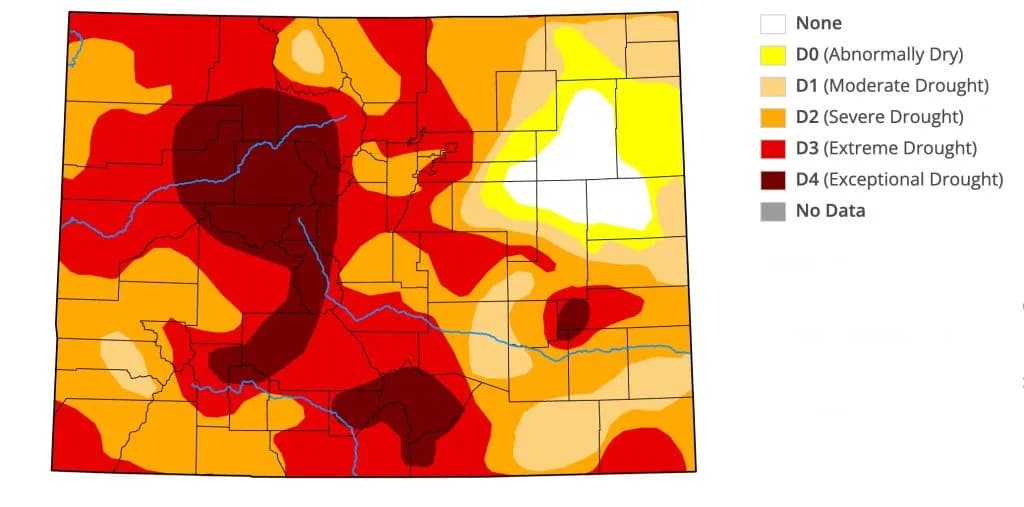
The backdrop for all this is severe. Eagle County is facing the most extreme drought conditions in the state. According to the U.S. Drought Monitor, the area is classified as "D4" or exceptional drought. It’s the highest category on the scale, a designation that signals a crisis beyond just inconvenience. It’s a condition where the land is parched, the streams are shrinking, and the legal frameworks designed to manage scarcity are fully engaged.
As the sun sets over the valley, casting long shadows across the dry grasses, the water continues its slow, steady descent toward the Gulf of Mexico. The current is clear, cold, and precious. Every cubic foot counts. Every diversion is a choice. And in the silence of the evening, with the wind picking up from the west, you can almost hear it whispering its warning to anyone who cares to listen. The call has been made. Now, the valley has to answer.
Keep up with Aspen
The day's Western Slope news, one email each morning. Free.