Front Range Passenger Rail District Picks CoCo as Official Name
The Front Range Passenger Rail District officially named its new multimodal transit system 'CoCo' after a public vote, beating out competitors like FRED to create a brand for the I-25 corridor rail project.
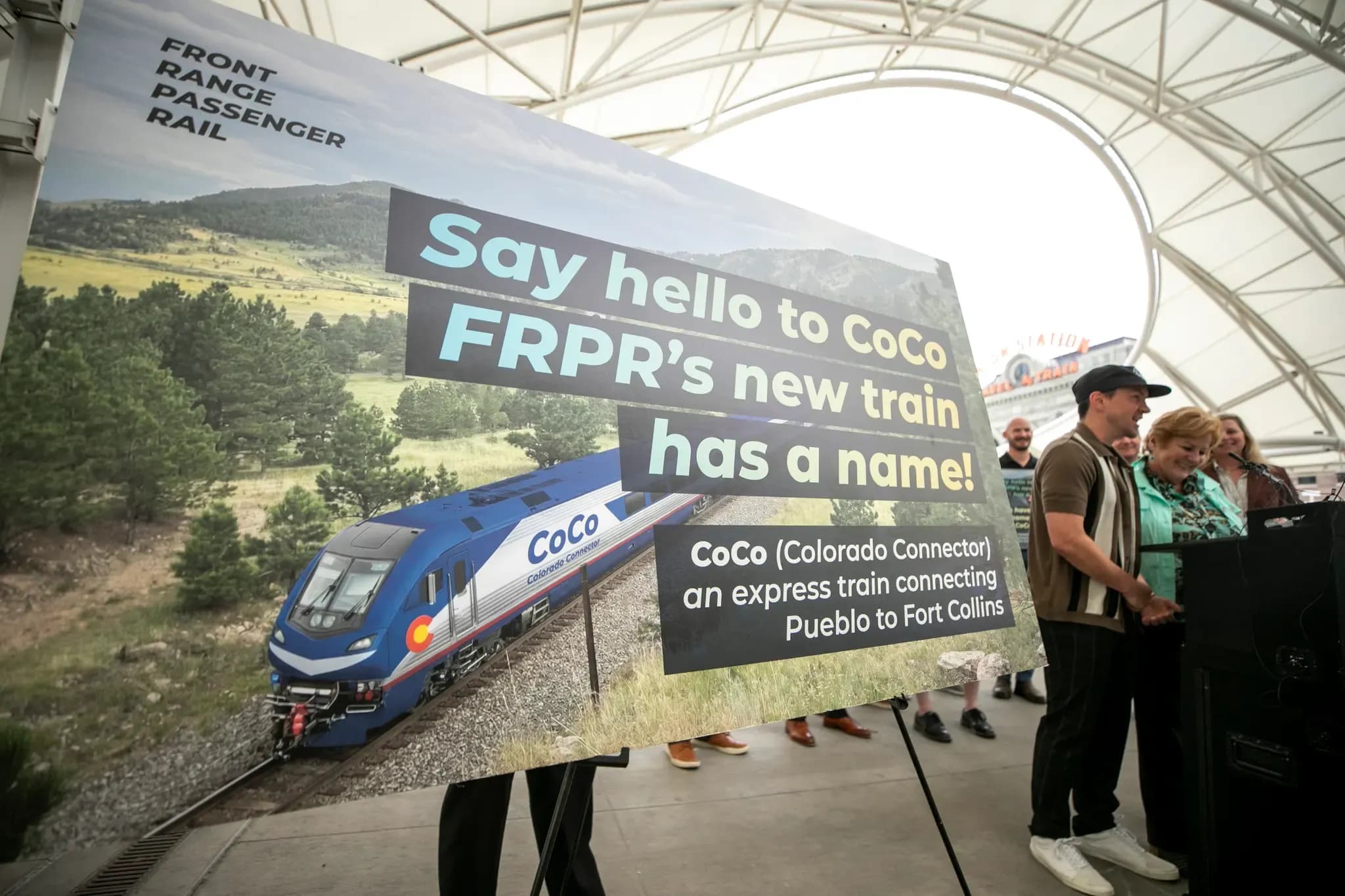
Colorado —The Colorado Connector is named CoCo.
Not Chocho. Not Choo-Choo. Just CoCo.
It sounds like a nickname for a grandmother or a golden retriever. It is not what you expect from a multimodal transit overhaul designed to siphon traffic off the I-25 corridor. But make no mistake: this is the official name. It won.
After more than 25,000 votes, the Front Range Passenger Rail District settled on CoCo. It narrowly beat out Front Range Express Destinations (FRED), Colorado Ranger, and RangeLink. FRED is dead. Long live CoCo.
Gov. Jared Polis called it playful. He said it describes what it does. It connects Colorado.
That’s the spin. The reality is heavier. This train is a serious infrastructure bet. It’s a partnership between Union Pacific Railroad, BNSF Railway, Amtrak, and RTD. It will run on existing freight tracks. It aims to reduce brake-light paralysis for the state’s growing population. It promises to make Colorado more livable and affordable.
The route stretches from Fort Collins to Pueblo. That’s a long haul. It stops in Loveland, Longmont, Boulder, Louisville, Broomfield, Westminster, Denver, Littleton, Douglas County, Colorado Springs, and Trinidad. Eventually, it might even reach Wyoming and New Mexico.
The first phase launches in 2029. That’s Denver to Fort Collins. The rest comes later.
Locals might scoff at the name. But the people who submitted the winning entry didn’t. Cora Zaletel and her son Tyler Shown, who live in Pueblo and Denver respectively, pitched it. They won the naming contest. Their family dog was named Coco. Cora was Aunt Coco to her nieces. The name connects families across the state.
It’s sentimental. It’s personal. It’s also a branding strategy.
The goal isn’t just to move people. It’s to change how we move. The I-25 corridor is choked. This train offers an alternative. It uses tracks already laid down by freight railroads. That saves money on new right-of-way acquisition. It cuts construction time. It leverages what’s already there.
But here’s the catch: voters may be asked to OK a sales tax to speed up development.
That’s the price of admission. The state wants to build this. The federal government likely wants to fund it. But the locals? They have to pay for it. Or at least, they have to approve the tax that pays for it.
The name CoCo is easy to remember. It’s easy to say. It’s easy to put on a schedule. But the mission is anything but lighthearted. It’s about reducing congestion. It’s about connecting cities. It’s about giving Coloradans a way out of the car.
The trains will be branded CoCo. The platforms will say CoCo. The schedules will list CoCo.
Read that again.
The Front Range Passenger Rail District isn’t just building a train line. They’re building a brand. And they picked a name that sounds like a joke.
It’s a joke with a timetable.
The first phase hits the tracks in 2029. If the tax passes. If the construction stays on schedule. If the freight railroads don’t complain too much about sharing the tracks.
Until then, it’s just a name. A silly one. A winning one.
CoCo.
Keep up with Colorado
The day's Western Slope news, one email each morning. Free.
Federal Report Sets 200,000 Acre-Foot Water Conservation Target for Upper Basin
Colorado Parks and Wildlife Deploys Precision Drones for Weed Control