NASA Trains Artemis Astronauts in Gypsum’s Thin Air
NASA partnered with the Colorado National Guard in Gypsum to train Artemis II astronauts in high-altitude flight, using thin air and visual illusions to simulate lunar landing conditions.
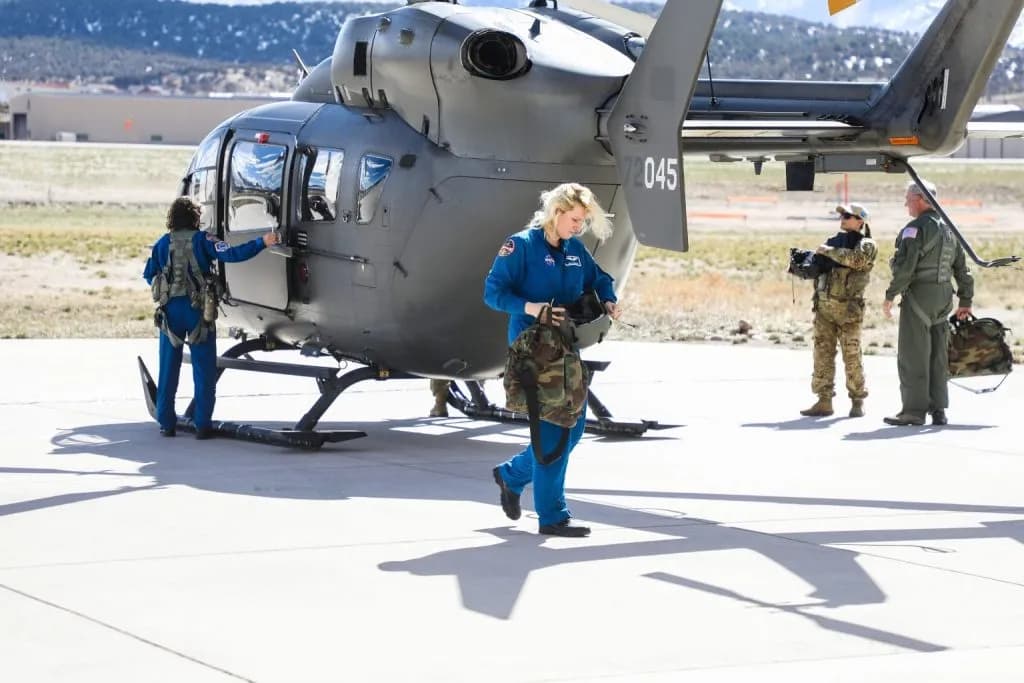
Aspen —The wind howls off the Elk Mountains, tearing at the rotors of CH-47 Chinooks hovering over Gypsum. It’s cold. The air is thin enough to make your head spin, a physical reminder that you’re operating in a different world than the one below. For the pilots of the High-Altitude Army National Guard, this isn’t just a commute. It’s a classroom.
Eight months before Reid Wiseman, Victor Glover, and Christina Koch launched toward the moon, they were standing in that same thin air. They were learning how to fly.
NASA didn’t just send them to a simulation center in Houston. It sent them to northwest Colorado. The agency partnered with the Colorado National Guard in 2021 to build a training course out of the High-Altitude Army National Guard Aviation Training Site, or HAATs, in Gypsum. The three American astronauts took part in this course last August.
The goal was specific. They needed to master the human landing system provided by SpaceX and Blue Origin. Ground training in Ohio and Texas can only do so much. It can’t replicate the visual illusions of a high-altitude landscape. It can’t force a pilot to trust their instruments when the horizon blurs and the air thins. The mountains around Gypsum offer a real-world environment that mimics the chaotic approach of a lunar landing.
This isn’t just about flying. It’s about survival. Artemis II is the first human-crewed flight in this new program, launching 56 years after Apollo’s last flight. The mission’s primary job is to test the Orion spacecraft. It has to prove the life-support, launch, navigation, and ground systems work in deep space. If Orion fails, the astronauts die. If the landing system fails, they’re stuck on the lunar surface.
The crew left Earth’s orbit on April 1 aboard the Orion spacecraft. Jeremy Hansen, a mission specialist from the Canadian Space Agency, joined them. Together, they are making history. They are the first humans in over five decades to travel to the lunar vicinity. Their 10-day flight is already rewriting the record books. They ventured further from Earth than any humans since Apollo 13 in 1970. They traveled 252,752 miles. They became the first to view parts of the moon’s far side. They carried the first woman and the first person of color to the lunar vicinity. They even captured a full lunar eclipse.
The mission is a milestone. It sets the foundation for future Artemis flights and the eventual push to Mars. But the path to the moon starts in the Rockies.
The training at HAATs in Gypsum gives the astronauts a chance to practice flight skills in an environment that doesn’t forgive mistakes. The thin air and varied landscapes create visual distortions that ground-based simulators simply can’t match. When you’re flying a helicopter in the Colorado high country, you’re learning to read the land. That skill translates directly to reading the lunar surface when you’re 240,000 miles from home.
Artemis II is expected to touch back down on Friday evening off the coast of San Diego. The crew will return to a world that has changed in their absence. The technology they tested will determine whether we go back to the moon regularly. It will determine whether we ever make it to Mars.
The short version is this: NASA didn’t just build a better rocket. It built a better pilot. And it did it in Gypsum.
The mountains don’t care about your budget. They don’t care about your press releases. They just are. And for eight months, the Artemis crew had to learn to live in them. That’s the reality of space travel. It’s not just about leaving Earth. It’s about understanding how to survive in places that want you dead.
The record-breaking distance is impressive. The diversity of the crew is historic. But the real story is the training. It happened here. In the cold. In the thin air. In the shadow of the peaks.
Read that again. The future of human spaceflight is being forged in a valley in northwest Colorado. Not in a sterile lab. Not in a desert in Texas. In the high country.
The astronauts are coming home. But the lessons they learned in Gypsum will stay with them. And with us.
Keep up with Aspen
The day's Western Slope news, one email each morning. Free.

S&P 500 Slips Modestly as Weak Retail Sales and Oil Prices Drive Market Correction
Aspen Essay Connects Generations Through Highway 82 Landmarks