Nepal Floods Kill 788 as Bhotekoshi River Threatens Fresh Disaster
Nepal's flood death toll reached 788 with 2,502 missing as authorities warned of renewed Bhotekoshi River flooding after upstream water levels rose.
Aspen —Sharmila Tamang stood in the ruins of her life in Dhading, Nepal, and delivered a verdict that cut through the fog of disaster: “Everything is finished. Nothing is left. Not even our home.”
She wasn’t speaking metaphorically. She was sitting in a house where the walls had been washed away, shoveling sludgelike mud off a window frame. Beside her, a neighbor scanned the ground, picking out a shoe from the silt. It was a quiet, grim scene of triage. People weren’t screaming; they were sorting.
The Vail Daily reported that this quiet devastation was happening under the shadow of a new threat. Authorities warned of possible fresh flooding on Sunday. Water levels in the Bhotekoshi River had risen. The warning came after Chinese authorities informed their Nepalese counterparts of increased water flow upstream. Dharam Raj Uprety, chief executive of Nepal’s National Disaster Risk Reduction and Management Authority, confirmed the alert.
It’s a precarious situation. The previous week’s catastrophic floods had already killed at least 800 people and left more than 3,000 missing in Nepal and Tibet. The death toll in Nepal alone had climbed to 788, with 2,502 still missing. Those missing numbers include hundreds of people from over a dozen countries — workers, visitors, and pilgrims. Chinese state media noted that 261 foreigners were missing in Tibet, including over a hundred Nepalis.
The danger isn't just the water coming now; it’s the water that’s already trapped. The Chinese state news agency Xinhua, citing the country’s water resources ministry, said a new lake formed high in the mountains after Wednesday’s floods had largely drained. But a crater located 3½ miles upstream still held an estimated 1.4 million cubic meters of water. That volume is a ticking clock.
Back in Dhading, the focus was on salvage. One man had returned to his property and found his chickens alive. He tied them up and loaded them into the cabin of his truck. It was a small victory, a tangible thing to hold onto.
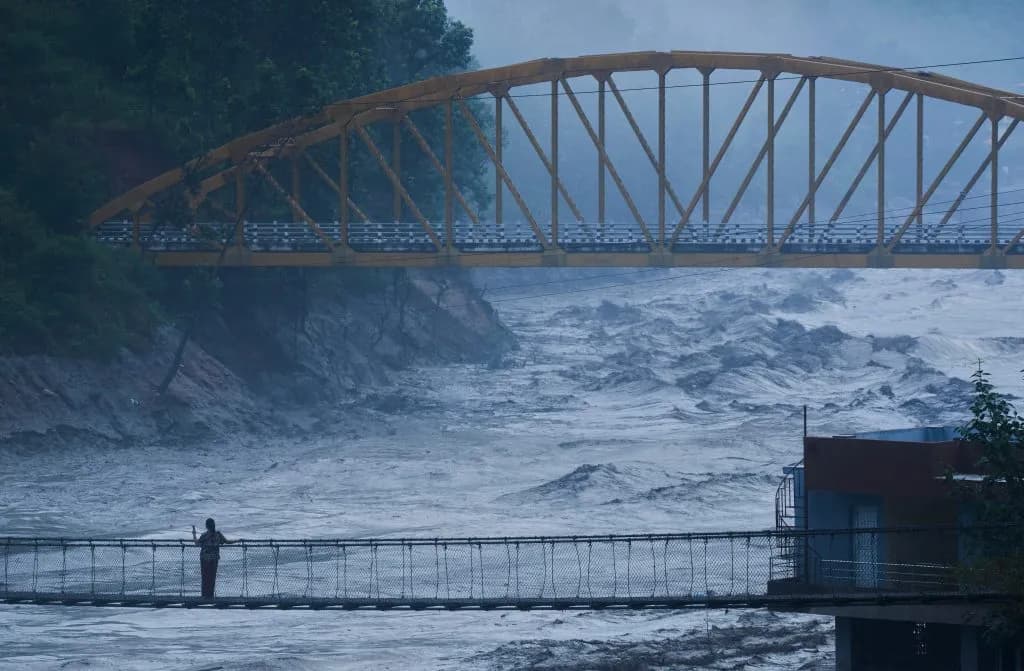
In the town of Galchhi, the mood was more tense. A group of residents sought higher ground on a nearby bridge. They watched as the river roared by below. Some pointed to enormous rocks that had been washed downriver during the earlier floods. Others standing on a suspension bridge were warned off with whistles, their feet hovering over the churning brown water.
Along the riverbanks, the landscape looked alien. Homes, vehicles, and farm tractors jutted out of the thick gray-brown sediment that enveloped entire villages. Parts of rice terraces along the riverside had dropped into the river after landslides hit them. The infrastructure that served over 20,000 people across four districts, including a key power plant, was severely damaged. Workers started inspecting the facilities Sunday to survey the destruction, their boots sinking into the mud.
The warning notices had gone out to phones early Sunday. Rescue crews were working to clear a major highway connecting Kathmandu to one of the areas worst hit. The road was a lifeline, but it was clogged with debris.
Stand there long enough and you realize the scale of it. It’s not just one village; it’s a corridor of loss. The Bhotekoshi River doesn’t care about borders or nationalities. It takes what it wants.
In Dhading, Sharmila Tamang continued to shovel. The mud was heavy. She paused, wiping her brow with the back of her hand. Her eyes were fixed on the horizon, where the river met the sky. The sun was beginning to set, casting long shadows across the ruined fields.
The river roared on, indifferent to the people watching from the bridge. The whistle blew again, sharp and urgent. The crowd shifted, stepping back from the edge. The water churned, carrying the remnants of lives downstream.
In the cabin of a truck parked on the shoulder, the chickens pecked at the floorboards. The driver checked his phone. No new messages. He turned the key in the ignition. The engine coughed, then caught. He pulled out onto the highway, merging into the slow-moving traffic.
Behind him, the mud dried in the evening air. The houses stood empty, their windows gaping like mouths. The rice terraces lay broken, half-submerged. The crater upstream held its breath.
The warning was still active. High alert.
In Dhading, the last light faded. The mud settled. The river kept moving.
Keep up with Aspen
The day's Western Slope news, one email each morning. Free.