RFTA Deploys 11 Electric Buses to Maroon Bells
The Roaring Fork Transportation Authority launches 11 new battery-electric buses on Sept. 20, doubling the region’s clean-fleet capacity and bringing silent transit to the Maroon Bells trailhead for the first time.
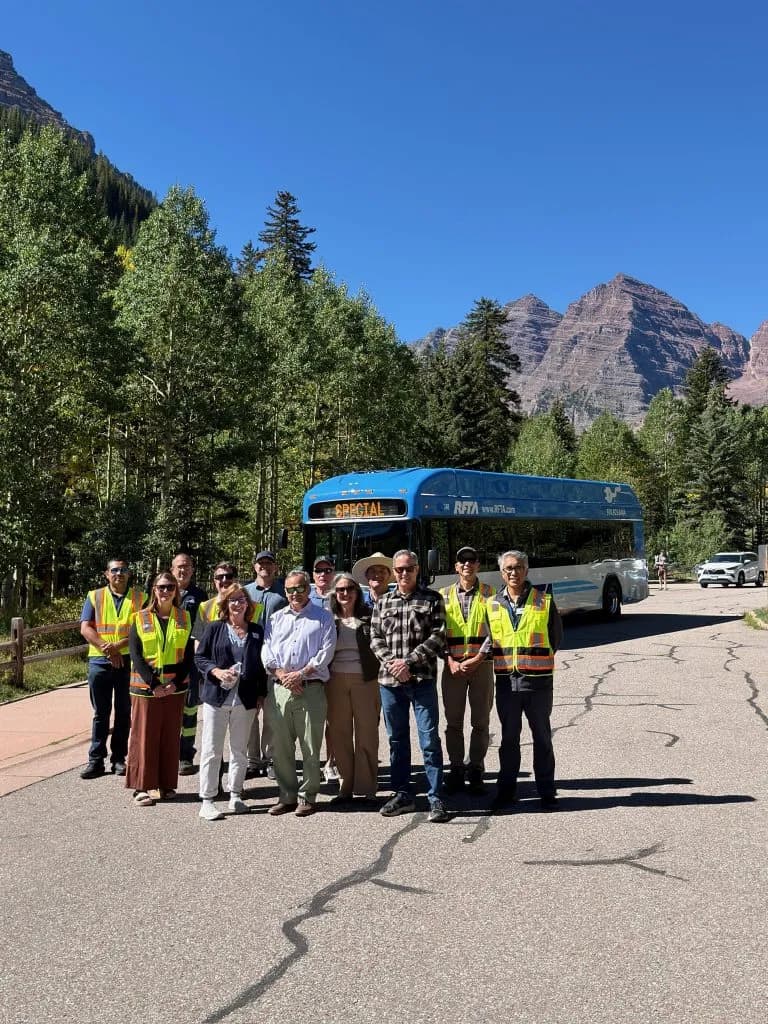
Aspen —The air is thin and still at the Maroon Bells trailhead. For decades, the only sound to break that silence was the idle of a diesel engine or the crunch of tires on gravel. This fall, that changes.
For the first time in history, visitors will arrive at one of Colorado’s most photographed landscapes on a battery-electric bus. The Roaring Fork Transportation Authority (RFTA) is rolling out 11 new electric vehicles on Sept. 20, a move that more than doubles the region’s clean-fleet capacity to 19 buses. It is a quiet revolution, both literally and figuratively.
Greg Poschman, the RFTA board chair and Pitkin County commissioner, tested the new fleet on Wednesday alongside project partners. He didn’t use flowery language to describe the ride up the mountain. “It was a dream come true for me,” Poschman said, noting the experience of riding to the Bells. “We rode up to the Bells, and it was remarkably quiet and silent on an electric vehicle.”
That silence is the point. The Maroon Bells shuttle system dates back to the 1970s, when officials moved to restrict car traffic due to pollution concerns. But the technology has finally caught up with the ambition. RFTA first piloted eight battery-electric buses in 2019, but those early models had a limited range. They couldn’t handle the steep grades or the long hauls required for regional service.
Jamie Tatsuno, RFTA’s public information officer, explained that the new buses fill a gap the previous generation couldn’t. The original electric vehicles struggled to consistently serve the Brush Creek corridor, peak commuter regional service, and the Hogback route. The new fleet can travel around 250 miles on a single charge, twice the range of the 2019 pilot buses. That extra mileage is what unlocks new routes, like the Maroon Bells, without needing to stop and recharge mid-route.
The money is real, but it isn’t local tax dollars doing the heavy lifting. Ten of the new buses were fully funded by over $12 million in grant money from two state of Colorado grants. The city of Aspen purchased the 11th bus separately for approximately $1.25 million, according to a staff report submitted to the Aspen City Council in May 2025. The city’s report notes that while it has been successful with grant awards for other vehicles, this particular replacement vehicle was not awarded funding and will be purchased in total by the 141 fund.
It’s a significant investment, but one that comes with a caveat: the weather. Operating electric buses in the Rockies is not like operating them in Phoenix or Miami. Tatsuno acknowledged that maintenance staff have had to navigate new challenges associated with the technology. “Cold temperatures and steep grades can reduce battery range,” he said. The staff is working to keep the buses operating reliably, but winter will be the true test of this new fleet.
Beyond the scenic route to the Bells, these buses will operate on Aspen routes, VelociRFTA Bus Rapid Transit, and the Flyer. For commuters in the valley, this means a quieter ride to work. For travelers, it means a cleaner way to see the Bells. The part everyone skips past is that this isn’t just about saving the environment; it’s about fixing a service gap. The old electric buses were too weak for the job. These aren’t.
The authority is one step closer to its larger Climate Action Plan Goals, having made a commitment to expand the electric fleet. But for now, the story is simpler: a bus that doesn’t rumble, a trailhead that stays quiet, and a region betting on the range of its batteries to keep moving.
As the sun sets over the Bells, casting long shadows across the valley floor, a new bus pulls into the lot. No exhaust fumes linger in the air. Just the wind, and the silence of a machine that finally fits the landscape it serves.
Keep up with Aspen
The day's Western Slope news, one email each morning. Free.