Yampa Valley Farmers Face Record Low Snowpack and Early Runoff
Sam Calahan reports that Yampa Valley snowpack is tracking worse than historic lows, threatening agriculture with an early, short-lived runoff season.
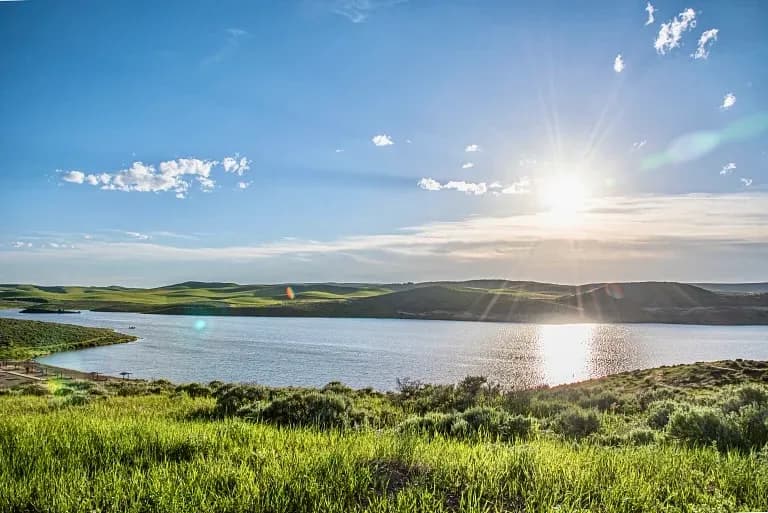
Steamboat Springs —The wind off the Elkhead Mesa doesn’t just bite; it carries the dry, dusty weight of a winter that refused to deliver. Standing near the reservoir’s edge, you can see the water line receding from the banks, exposing wide swathes of cracked mud that look like ancient pottery shards. It’s a visual that tells you everything you need to know before the hydrographs even drop.
Sam Calahan, a water resources specialist with the Colorado River District, has been watching this unfold with the grim focus of a pilot who knows the plane is running on fumes. He’s not guessing anymore. He’s looking at data that suggests this year’s snowpack is tracking at record lows, and the runoff is expected to follow suit.
“We haven’t seen a year like this in a long time,” Calahan said. “Our snowpack is looking substantially worse than 2002 and 2012, and we’re expecting runoff to be worse than both of those years.”
Those earlier drought years are the benchmarks across the Rocky Mountain West. They’re the reference points for farmers deciding whether to plant corn or fallow their fields. But Calahan says current conditions suggest this year could fall below even those historic lows. That’s not just a statistic for the folks in Craig or Hayden; it’s a threat to the irrigation ditches that feed the valley’s agriculture.
The problem isn’t just that it’s dry. It’s that it’s warm.
Warm, dry conditions have accelerated the melt, creating a runoff season that arrives early, peaks quickly, and then fades out. In a typical year, gradual warming allows the snowpack to melt slowly, sustaining river flows well into the summer. This year, that prolonged runoff is not materializing. The water is coming, but it’s coming in a rush, and it’s leaving fast.
“If we continue having the dry weather and warmth that we’re having, we’re looking at an early and short-lived runoff,” Calahan said.
That uncertainty leaves reservoir managers balancing how much water to store versus how much to release to meet downstream demand. It’s a tightrope walk. If they hold back too much, they risk missing the window for irrigation. If they release too much, they leave themselves exposed if a late summer monsoon fails to materialize. And officials don’t expect conditions to return anywhere near an average water year, even with some late spring storms.
The pressure hits hardest when the river goes under “call.”
In dry years, rivers like the Yampa come under what is known as a call, when senior water rights holders are not receiving their full allocation. When that happens, upstream users with junior rights can be curtailed. Calahan expects the river to be under administration for a much longer period than normal. That means Elkhead Reservoir water will be released to help fulfill contractual obligations and support users who might otherwise face shortages.
“The bigger users are definitely agriculture,” Calahan said, adding that municipal diversions tend to be much smaller by comparison.
But “much smaller” doesn’t mean negligible. For the towns relying on those municipal diversions, every acre-foot counts. And for the agricultural irrigators, who make up the bulk of the system’s stakeholders, the margin for error is razor-thin. They’re not just watering crops; they’re managing a business that depends on a reliable water schedule that this year is anything but reliable.
Picture this: a farmer in the Yampa Valley checking his soil moisture, knowing that the snowmelt that usually sustains his fields through July and August might be gone by June. The river is under administration. The water is being released upstream to meet calls. He has to decide whether to plant now and hope for the best, or let the land lie fallow and take the loss.
It’s a hard decision. And it’s one that’s becoming more common.
The broader implication here is about resilience. The Western Slope has dealt with drought before. But this is different. This is a year where the snowpack is worse than the benchmarks we use to measure crisis. It’s a year where the warmth is accelerating the melt, turning a slow, steady stream into a flash flood that disappears as quickly as it arrives.
Calahan and his team are doing the math, crunching the numbers, and making the calls. But the math is simple: there’s less water, and it’s arriving faster. The question isn’t whether the system will hold. The question is how much stress it can take before something breaks.
And that matters because the break might not be a dam bursting. It might be a livelihood vanishing. It might be a town waking up to find its water rights curtailed, leaving them with less than they need to survive the summer.
The snow is melting. The flow is moving. And somewhere out there, a farmer is watching the gauge, waiting to see if it holds.
Keep up with Steamboat Springs
The day's Western Slope news, one email each morning. Free.