Yampa Valley Solar Arrays Save $1.34 Million for Craig and Hayden
Yampa Valley's 13-site solar corridor has generated $1.34 million in operational savings, keeping utility rates stable for Craig and Hayden residents through reduced energy costs at key facilities.
Steamboat Springs —A $1.34 million savings. That’s the number McKinstry and the CoPIRG Foundation are waving around to prove that solar isn’t just a green hobby for municipalities — it’s a budgetary lifeline.
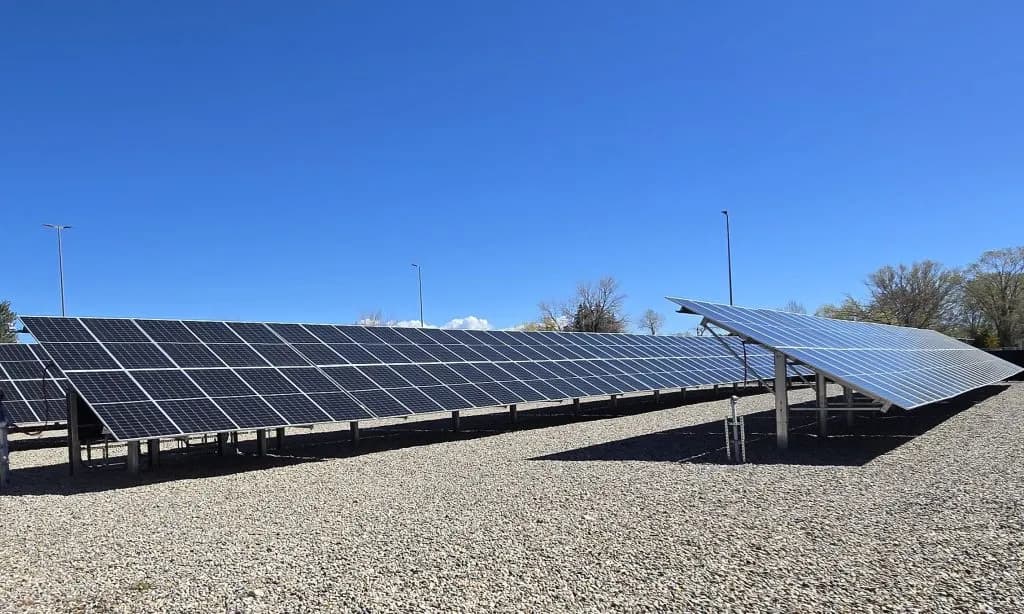
The Yampa Valley Solar Corridor Tour on Tuesday wasn’t just a photo op for officials; it was a receipt check. Thirteen public facilities across Moffat and Routt counties, running on 2,266 kilowatts of capacity, have been eating sunlight instead of expensive grid electricity for over four years. The result? Operational savings that local governments are actually passing down to you.
Let’s look at the math, because the numbers here are specific. Roy Tipton, the former Moffat County director of development services, pointed out that the 207kW array at the Moffat County Courthouse saves the county at least $30,000 annually. That’s not a projection. That’s a realized saving. The array, paid for upfront via grants, now covers at least 40% of the courthouse’s electricity needs. And crucially, it’s tackling the biggest cost driver: air conditioning. In Craig, where summer heat spikes cooling loads, that’s a direct offset to inflation.
Carl Ray, Craig’s water and wastewater director, put it in terms that matter to your wallet. The combined 465kW solar installations at the city’s water and sewer plants help keep rates under control. Water processing is energy-intensive. If the solar field performs — as Ray says it has, "as good or better than expected", then every kilowatt generated reduces the operational drag on the system.
“Any revenue that we can save, that savings is passed along to our customers,” Ray said.
It sounds simple. It is. But the scale is what makes this notable. We’re talking about 13 distinct sites. From the Craig Water Treatment Plant to the Hayden Police Station. From the Steamboat Transit hub to the Yampa Valley Regional Airport. Even town halls in Oak Creek and Yampa got in on the action. All but one of these projects wrapped up in November or December 2021. The Moffat County Courthouse array, fenced in and operational since August 2023, is the only recent addition.
The infrastructure is mostly ground-mounted on vacant land adjacent to high-use facilities, with some rooftop installations thrown in. The total capacity sits at 2,266 kilowatts. It’s not a massive utility-scale farm, but it’s distributed enough to impact multiple municipal balance sheets simultaneously.
Kirsten Schatz with the CoPIRG Foundation wants to use this as a template. “We want to see more projects like these in Colorado, and plant some seeds in other communities,” she said. They’re treating these 13 sites as proof of concept. The argument is that if a county courthouse and a water plant can do it, other public buildings should too.
The financial mechanics are straightforward. The initial projects were funded through grants, meaning the upfront capital didn’t come entirely from local tax levies or bond measures in the traditional sense. The savings are immediate. Tipton noted the courthouse array is already paying for its share of the energy bill. Ray confirmed the water plant solar field is doing its job.
This isn’t about future promises. It’s about current bill reduction. When a facility like the Craig wastewater treatment plant cuts its energy load, the fixed costs of maintaining that plant are spread over a lower energy base, or simply reduced, allowing rate setters to keep the line steady.
For the folks in Craig and Hayden, the impact is subtle but real. It’s the difference between a rate hike and a flat rate. It’s the $30,000 that stays in the county budget instead of going to the utility company. It’s the stability of knowing that a significant chunk of your local government’s power bill is locked in at zero marginal cost for the next two decades.
The tour highlighted that this isn’t experimental tech. It’s installed, fenced, and functioning. The bifacial panels at the courthouse are generating. The water plants are running. The savings are being counted.
The bottom line is that solar has moved past the "nice to have" phase for these municipalities. It’s a cost-containment strategy. If you’re wondering why your water rates haven’t spiked in lockstep with energy inflation, look at the 465kW of panels sitting next to the treatment plant. That’s the buffer.
Keep up with Steamboat Springs
The day's Western Slope news, one email each morning. Free.