Yampa Valley Solar Arrays Save $1.34M for Public Facilities
Yampa Valley public facilities have saved over $1.34 million in electricity costs through commercial-scale solar arrays, demonstrating how green energy stabilizes utility rates for taxpayers.
Steamboat Springs —“Any revenue that we can save, that savings is passed along to our customers.”
Carl Ray, Craig’s water and wastewater director, didn’t mince words when explaining why the solar arrays humming quietly behind the city’s treatment plants matter to folks paying their utility bills. It’s not just about green energy; it’s about keeping the lights on without hiking rates.
The Yampa Valley Solar Corridor Tour on Tuesday wasn’t just a photo op for municipal staff. It was a data dump on how 13 public facilities across Moffat and Routt counties have turned sunlight into savings. The numbers are specific, and they’re real. More than $1.34 million in electricity bill savings. That’s money that doesn’t have to come out of your pocket or the county’s general fund.
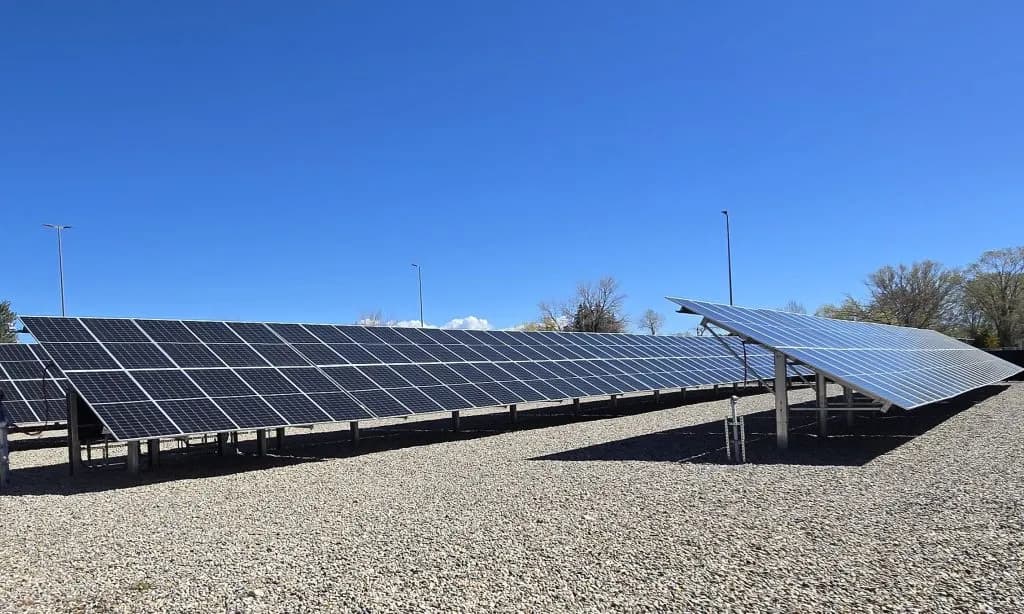
The project, led by energy services company McKinstry and the nonprofit CoPIRG Foundation, covers a combined 2,266 kilowatts of capacity. That’s not a backyard setup. These are commercial-scale installations, mostly ground-mounted on vacant land next to high-energy buildings, with a few rooftop arrays thrown in for good measure.
Let’s look at the courthouse. Roy Tipton, former Moffat County director of development services, pointed to the 207kW array sitting on the east side of the building. It’s been running since August 2023. The result? At least $30,000 in avoided energy costs every single year. Tipton noted that this array covers at least 40% of the courthouse’s electricity needs. And here’s the kicker: it covers the biggest cost driver — air conditioning. Colorado summers don’t get any easier on HVAC systems, and this array is doing the heavy lifting.
The rest of the system came online in late 2021. Thirteen sites. All but one finished by December 2021. The list reads like a tour of local government infrastructure: the Moffat County Safety Center, Moffat County High School, Craig Water Treatment Plant, Hayden Police Station, Hayden Community Center, Steamboat Transit, town halls in Oak Creek and Yampa, Yampa Valley Regional Airport, and the wastewater plants in Craig, Hayden, and Steamboat Springs.
Ray, the Craig water director, said the performance of the 465kW solar field at the city’s water and sewer plants has been “as good or better than expected.” Processing water takes a massive amount of energy. By offsetting that usage, the county keeps rates stable. It’s a simple equation: lower energy costs for the facility means lower pressure to raise rates for the customer.
Kirsten Schatz with CoPIRG wants this model replicated. “We want to celebrate these projects and also lift them up as examples,” she said. “We want to see more projects like these in Colorado, and plant some seeds in other communities.”
It’s easy to dismiss solar as a luxury for wealthy suburbs or a complex engineering puzzle for large utilities. But this is different. These are public facilities. They are funded through grants and upfront capital, not endless municipal bonds that sit on shelves for decades. The systems are built. They are fenced in. They are producing power.
The financial impact is immediate. The $1.34 million in savings isn’t a projection from five years in the future. It’s accumulated from the moment the panels started flipping. For the county, that’s operational flexibility. For the city, it’s rate stability. For the taxpayer, it’s a direct reduction in the cost of doing business with local government.
There’s no ambiguity here. The technology works. The math adds up. The question isn’t whether solar saves money in this valley. The question is why it took so long to put more panels on more roofs.
Keep up with Steamboat Springs
The day's Western Slope news, one email each morning. Free.