Colorado Capitol Yields 119-Year-Old Time Capsule Secrets
A 119-year-old time capsule discovered at the Colorado Capitol reveals the state's rich and complex history through newspapers, letters, and other artifacts
Western Slope —As you stand on the worn stone steps of the Colorado Capitol, the warm sunlight casting a golden glow on the historic building, it's hard not to wonder what secrets the past holds, what stories lie hidden beneath the surface of this iconic landmark. And now, thanks to the discovery of a 119-year-old time capsule, we're getting a glimpse into the state's rich history, a history that's as complex as it is fascinating. The capsule, a tin box, was found unexpectedly last year, buried beneath the pedestal of a long-gone monument, and its contents have been revealed, offering a unique window into the lives of Coloradans from a bygone era.
The story of the time capsule's discovery is a fascinating one, full of twists and turns, like the winding roads that crisscross our state. It was found during the preparation for a new memorial, one that will honor the victims of the Sand Creek Massacre, a dark chapter in Colorado's history. As workers removed the remaining pedestal base of the old monument, they stumbled upon the tin box, hidden away for 119 years. The monument, "On Guard," had stood tall since 1909, commemorating Colorado’s veterans of the Civil War, but it was toppled in 2020, during the protests that swept the nation, demanding racial justice. Now, the monument stands as an exhibit at the History Colorado Center, a reminder of the state's complex past.
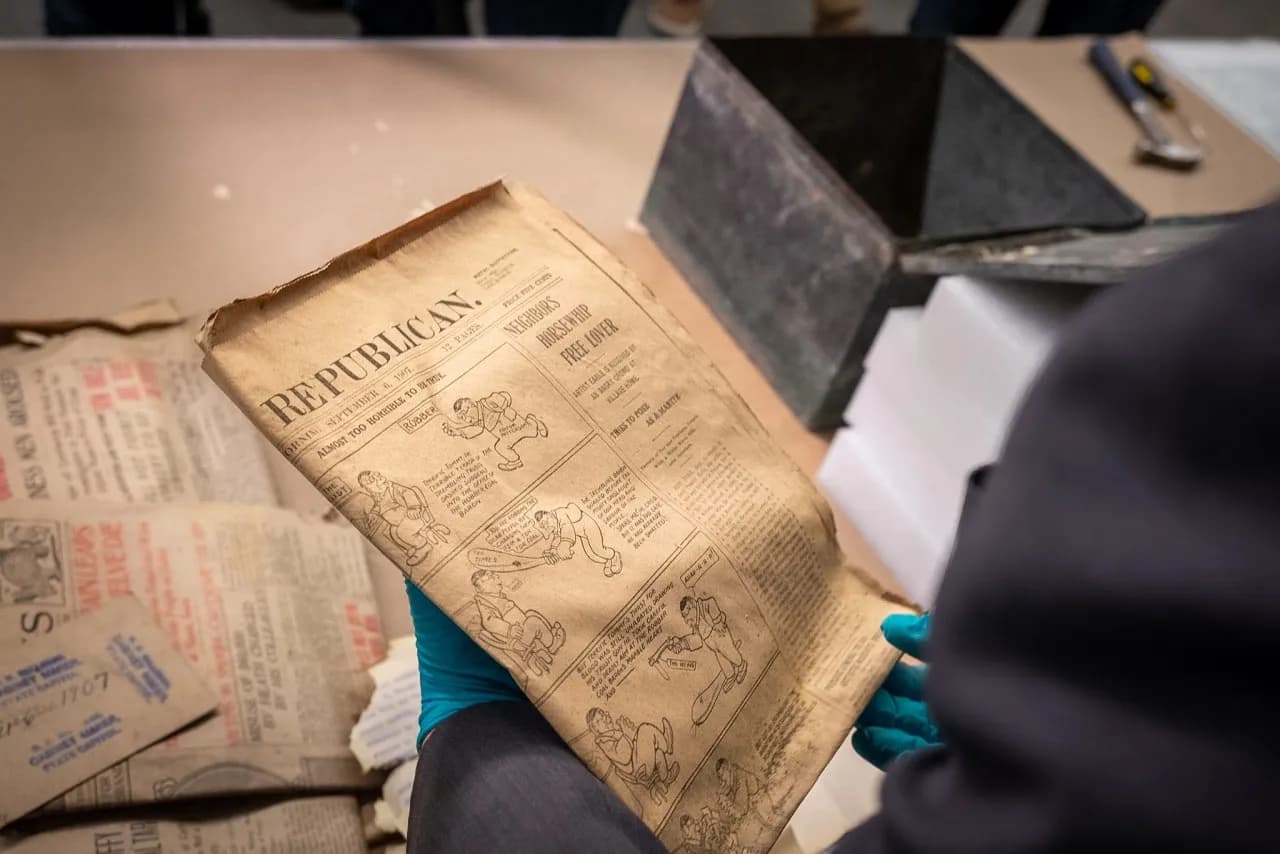
As the time capsule was carefully opened, the contents were revealed, a treasure trove of historical artifacts, each one telling a story of its own. There were newspapers from The Denver Post, The Denver Republican, The Denver Times, and The Rocky Mountain News, their yellowed pages crackling with age, like the sound of leaves rustling in the autumn breeze. A two-page typewritten letter, its ink faded but still legible, offered a glimpse into the thoughts and feelings of the people who lived in Colorado during that time. Business cards, once crisp and new, now worn and faded, told the story of the state's thriving economy, of the people who built and shaped our communities. And a booklet of legislative acts, its pages filled with the dry language of bureaucracy, revealed the process of how the monument was installed, a result of the efforts of government and the people who shaped it.
But what do these artifacts tell us about our state's history, about the people who came before us? They tell us a story of complexity, of contradictions, of a state that's both beautiful and flawed. They tell us about the struggles and triumphs of the people who built our communities, who shaped our history. And they remind us that our past is not just a series of dusty relics, but a living, breathing thing, a thing that shapes us still. As you look at these artifacts, you can't help but wonder, what would it have been like to live in Colorado in 1907, to walk the streets of Denver, to feel the sun on your face, the wind in your hair? What would it have been like to be a part of this vibrant, thriving community, to shape the course of history?
The discovery of the time capsule is a reminder that our history is all around us, hidden in plain sight, waiting to be uncovered. It's a reminder that our past is not just a series of dry facts, but a rich tapestry of stories, of people and places, of struggles and triumphs. And it's a reminder that we, as a community, have a responsibility to preserve our history, to tell our stories, to keep our past alive. As you stand on the steps of the Capitol, the wind whispering through the trees, you can feel the weight of history, the weight of the stories that lie hidden beneath the surface. And you can't help but wonder, what other secrets lie hidden, waiting to be uncovered, waiting to be told. The smell of old paper and dust wafts up, carrying with it the whispers of the past, a past that's still very much alive, still very much a part of us.
Keep up with Western Slope
The day's Western Slope news, one email each morning. Free.
Aspen's ACES Returns Annual Harvest Party to Rock Bottom Ranch
Glenwood Ghostwalk Brings Frontier History to Life in Linwood Cemetery

Georgie White’s Wild Legacy Challenges Outdoor Superwoman Myth
Mudslides Strand Visitors on East Portal Road After Heavy Rain

How Western Slope Residents Can Safely Wash Produce Amid Cyclospora Outbreak