President Calls for Unity After Washington Incident
The president's speech after a security breach in Washington D.C. emphasized the need for unity and cooperation among Americans, leaving many to wonder if this moment will lead to lasting change.
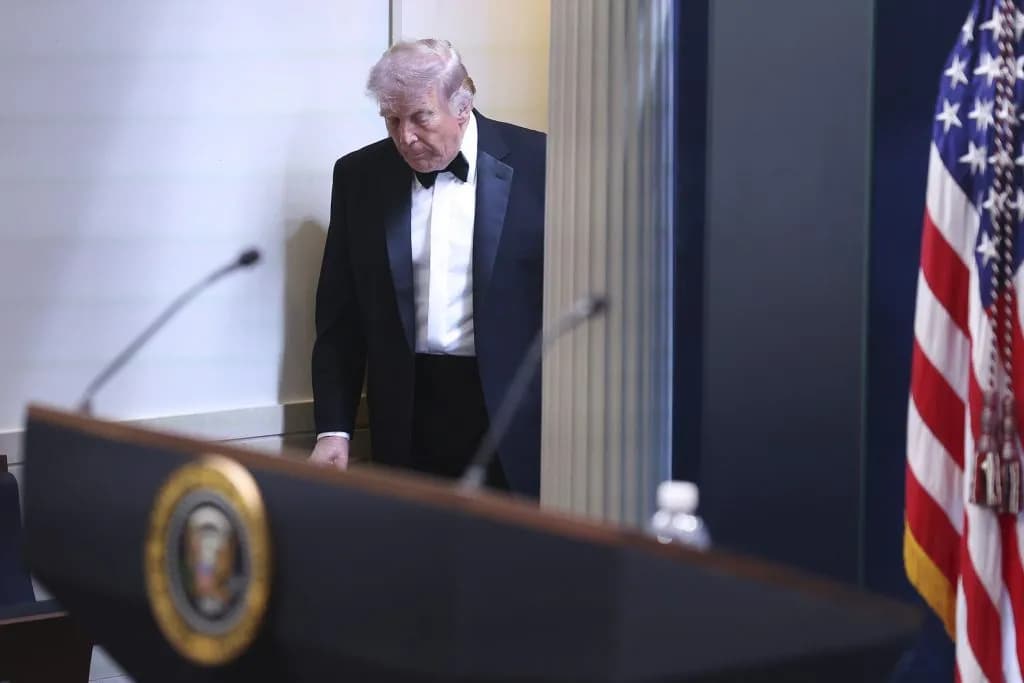
Aspen —As I stood in the crowded streets of Washington D.C., the sounds of sirens and murmurs of the crowd still echoing in my mind, I couldn't help but wonder if the president's words would be more than just a fleeting moment. The president's somber tone, a departure from his usual combative style, was a stark contrast to the violence that had just unfolded. A man, identified as Cole Tomas Allen, 31, of Torrance, California, had attempted to breach security at the Washington hotel where Trump was scheduled to speak, leaving many to ponder the escalating violence in the world of politics.
The president's words, laced with a sense of reflection, acknowledged the dangers of his profession, noting that "no country is immune" to the threats of violence. He spoke of the need for Americans to put aside their differences, to unite in the face of adversity, and to find common ground. It was a message that resonated deeply, particularly in the aftermath of an incident that could have had devastating consequences. As Trump said, "We have to, we have to resolve our differences," his voice a solemn reminder of the gravity of the situation.
But as I walked through the streets, taking in the sights and sounds of the city, I couldn't help but wonder if this moment of reflection would be short-lived. Would it be a momentary lapse into civility, or a genuine attempt to bridge the divides that have grown so wide in recent years? The president's own words, in which he suggested that his personal politics had made him a target, seemed to hint at a deeper complexity, one that would not be easily resolved. As he noted, "The people that make the biggest impact, they're the ones that they go after," his tone a mix of introspection and defiance.
As the day wore on, I found myself pondering the president's claim that he had planned to give a speech "of love" in the aftermath of the incident. It was a striking image, one that seemed to contradict the usual tone of his public addresses. And yet, as he spoke to Fox News Channel on Sunday, he reiterated this sentiment, describing the dinner as "an evening where a lot of people got together," and noting that even Democrats who had previously been hostile were waving and saying hello. It was a moment of unexpected warmth, one that seemed to transcend the usual partisan divides.
But as the news cycle moves on, and the incident fades from the headlines, I am left to wonder: will the president's appeal for unity and cooperation be more than just a temporary shift in tone? Will it be a turning point, a chance for Americans to come together and find common ground, or will it be lost in the noise of politics as usual? As I look out at the city, I am reminded of the complexities and challenges that lie ahead, and the difficult work of building bridges and finding unity in a world that often seems determined to drive us apart. The sound of the city, a constant hum of activity and debate, seems to echo the president's words, a reminder that the work of unity is never truly done, but always a work in progress.
Keep up with Aspen
The day's Western Slope news, one email each morning. Free.